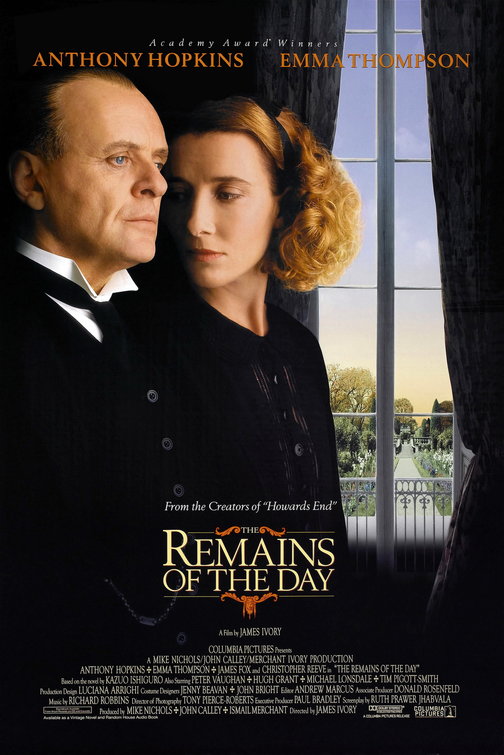
Kazuo Ishiguro’s The Remains of the Day and the 1993 Merchant-Ivory film made from it are both masterpieces, and comparing them is the best possible illustration of what adaptation can and cannot carry across.
The novel is a feat of interiority. It is narrated by Stevens, an English butler, in a voice so repressed, so committed to dignity and decorum, that the reader must read constantly between his lines to grasp the tragedy he cannot admit to himself — that he gave his entire life to a master who did not deserve it, and let the one chance at love pass him by while insisting nothing was wrong. The book lives almost entirely inside this gap between what Stevens says and what is actually true. It is a novel about self-deception, and only prose, with its access to a mind narrating itself, can render self-deception from the inside.
The film cannot get inside Stevens’s head, and so it does the only thing it can: it puts the tragedy on a face. Anthony Hopkins plays Stevens as a sealed vault, and the film’s genius is in the micro-expressions — the flicker of feeling instantly suppressed, the eyes that betray what the mouth will never say. What the novel achieves through unreliable narration, the film achieves through performance. We lose Stevens’s voice; we gain his face, and Hopkins’s face does extraordinary work. Emma Thompson, as the housekeeper who loves him, supplies the warmth he cannot, and their scenes together ache with everything unsaid.
What does not survive is the novel’s full architecture of denial — the layers of justification, the political naivety Stevens cannot see in himself, the slow dawning the reader does and Stevens does not. Film externalizes; it cannot easily dramatize a man lying to himself in the privacy of his own narration. But what the film adds is also real: the physical world of the great house, the specific gray beauty of it, the embodied presence of two people in a room failing to say the thing. The book makes you complicit in Stevens’s blindness. The film makes you watch it from outside, helpless.
Read the novel for the voice and the devastating interiority. Watch the film for the faces and the rooms. Neither replaces the other; together they show you the same heartbreak from the two places it can be told — inside a mind, and on a face — and that is exactly what the best adaptations teach.
Both halves of this one are worth keeping — Ishiguro's novel and the Merchant Ivory film.
Leave a Reply