Screen

Film and television — prestige, noir, slow-burn, and foreign.

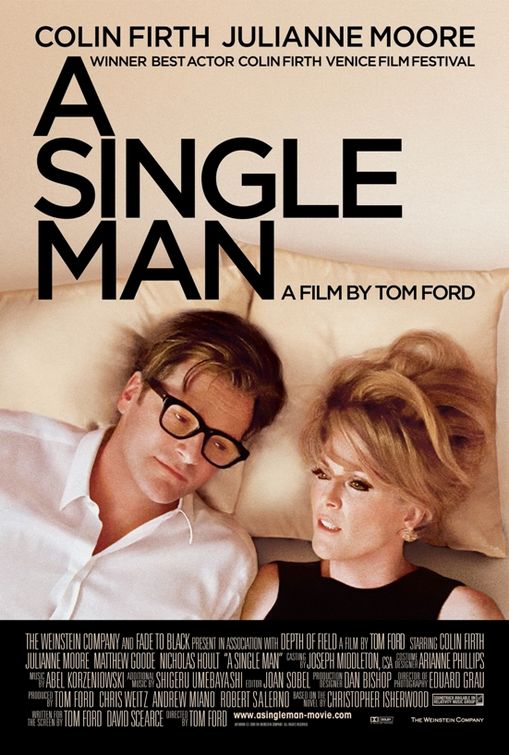
  • A Single Man

    A Single Man

    Tom Ford’s A Single Man could have been merely beautiful — the work of a fashion designer turned director, every frame styled to within an inch of its life. What makes it extraordinary is that the beauty is in service of grief, and the grief is real.

    Adapted from Christopher Isherwood’s novel, the 2009 film follows George (Colin Firth), a British professor in 1962 Los Angeles, through a single day — the day he has quietly decided will be his last. His partner of sixteen years, Jim, has died in a car accident some months before, and George, forbidden by the era from even openly mourning, has been moving through a world that does not acknowledge his loss. The film is the record of one day inside that suppressed, immaculate, drowning grief.

    Firth is astonishing, and was rightly recognized for it. He plays George as a man holding himself together by sheer discipline, every gesture controlled, the devastation visible only in the eyes and the smallest tremor of the hands. It is a performance built almost entirely on restraint, which makes the rare moments it cracks — a phone call delivering the news, a memory of Jim on a sofa with a dog — land like blows.

    Ford shoots the film as a series of saturations: the world goes gray and beautiful around George until something pulls him briefly back to life — a student’s face, a stranger’s kindness, a chance encounter — and the color floods in. It is a literal device and it should be too much, but it works, because it externalizes exactly what grief does: the way the world dims, and the way small beauties can, for a moment, make it almost bearable to stay in it.

    Beneath the impeccable surfaces is a film about whether a life is worth continuing, and it answers the question not with argument but with accumulation — the sensory pile-up of a single ordinary day, each small pleasure quietly making its case. The ending is both a mercy and a cruelty, and the film is honest enough to let it be both.

    Watch it for Firth, and for the strange consolation of a film that takes loss seriously while insisting, frame by gorgeous frame, that the world remains worth looking at.

    Ford composes every frame like a photograph; it holds up to owning. On Blu-ray.
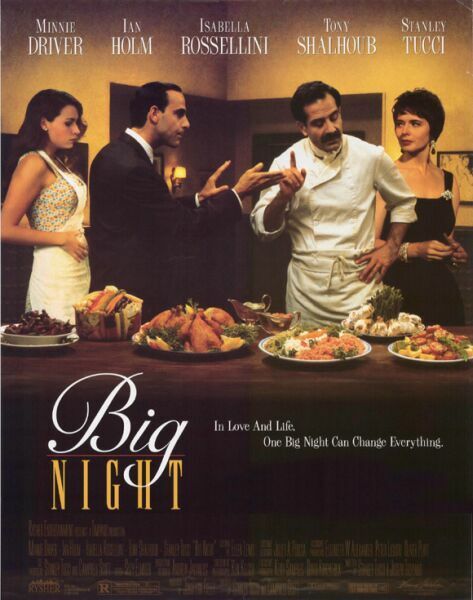
  • Big Night

    Big Night

    Most food films are about triumph. Big Night is about something rarer and truer — the dignity of doing something perfectly even as it fails.

    The 1996 film, directed by Stanley Tucci and Campbell Scott, follows two Italian immigrant brothers running a struggling restaurant on the Jersey shore in the 1950s. Primo (Tony Shalhoub) is a purist chef who refuses to dumb down his cooking for customers who want spaghetti with their risotto. Secondo (Tucci) is the front-of-house dreamer trying to keep the lights on. The restaurant is dying. So they bet everything on one big night — a single legendary meal — to save it.

    The film’s centerpiece is the timpano, an enormous drum of pastry filled with pasta, eggs, meat, and cheese, prepared with the reverence of a sacrament. Watching it made and then cut open is one of the great food sequences in cinema, not because it is showy but because the camera understands that for Primo this dish is not a meal — it is an argument about how to live, an act of love and stubbornness baked into a crust.

    What elevates Big Night above sentiment is its honesty about failure. The big night does not fix everything; the film is too wise for that. What it offers instead is the brothers’ relationship, tested and frayed and ultimately holding, and a final scene so quiet and so perfect that it has become legend — a single unbroken shot of Secondo making breakfast, eggs in a pan, no dialogue, the morning after, two brothers reconciling without a word.

    It is a film about the cost of integrity, the gap between art and commerce, and the things that survive when the business does not. The acting is uniformly wonderful, the food is photographed like portraiture, and the whole thing moves with the unhurried confidence of a meal you are in no rush to finish.

    Watch it hungry, with someone you would cook for. It will make you want to feed people — which is, in the end, the only review that matters.

    The kind of film you will want to revisit over a late dinner. It is available on Blu-ray.

  • Brief Encounter

    Brief Encounter

    Brief Encounter is the great film about the love affair that almost happens, and it remains, eighty years on, more devastating than a thousand films about the ones that do.

    David Lean’s 1945 masterpiece, written by Noël Coward, gives us Laura (Celia Johnson), a respectable married woman, and Alec (Trevor Howard), a married doctor, who meet by chance in a railway station tearoom when he removes a bit of grit from her eye. Over a few Thursdays they fall, quietly and completely, into a love that decency and circumstance will not allow them to act on. Almost nothing happens. It is unbearable.

    The film is narrated by Laura in flashback, confessing the whole thing in her head to the husband who sits across from her doing the crossword, oblivious. That framing is the masterstroke: we watch a passion of overwhelming force playing out behind the face of a woman pouring tea, and Johnson’s performance — all restraint, all the feeling pressed down beneath an English composure that is itself a kind of tragedy — is one of the finest ever filmed.

    Lean shoots the railway station as a place of constant departure, steam and whistles and the clock always pushing them toward the next train home. Rachmaninoff’s Second Piano Concerto swells beneath them, lush and enormous, voicing everything the characters are too proper to say aloud. The contrast between the operatic score and the buttoned-up behavior is where the film breaks your heart.

    What makes it timeless is its moral seriousness. The film is not interested in whether they should sleep together; it is interested in the cost of feeling something this large in a life with no room for it. Their restraint is not coldness — it is a wound they choose, again and again, out of duty to people who will never know what it cost them.

    It is a film about goodbye, and about the ordinary heroism of going home. Watch it when you are willing to be moved by what people do not do. The final scene, in that tearoom, with a chattering acquaintance filling the silence where a farewell should be, is as quietly shattering as cinema gets.

    A film this quietly devastating deserves a proper edition. The Criterion release is on Blu-ray.

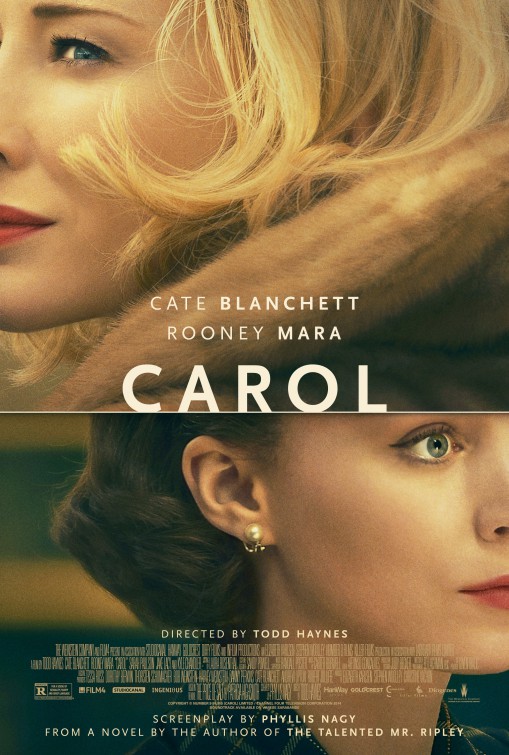
  • Carol

    Carol

    Some films are about desire. Carol is made of it — woven into the grain of every frame until you stop watching the plot and start watching the air between two people.

    Todd Haynes’s 1952-set romance, adapted from Patricia Highsmith, gives us Therese (Rooney Mara), a shopgirl with a camera and no clear idea what she wants, and Carol (Cate Blanchett), an older woman in the middle of a divorce who knows exactly what she wants and exactly what it will cost. They meet across a department-store counter at Christmas. Almost nothing is said. Everything is understood.

    What makes the film extraordinary is its discipline. Haynes shoots through windows, through rain-streaked glass, through the reflections in car doors, so that the lovers are forever framed and separated by surfaces. Longing becomes a kind of weather — fogged, indirect, pressing at the edges of every scene. The camera lingers on a gloved hand on a shoulder for half a second longer than decorum allows, and that half-second carries more heat than most films manage in an hour.

    Blanchett plays Carol as a woman performing composure over fear, her voice a low instrument she keeps perfectly tuned in public and lets crack only in private. Mara, opposite her, does the harder thing: she plays someone learning, in real time, that she is allowed to want at all. Carter Burwell’s score circles beneath them like something half-remembered.

    The period setting is not nostalgia. It is pressure. Every beautiful object — the furs, the lipstick, the chrome — is also a constraint, a world that has decided in advance what these women are permitted to feel. The film’s quiet triumph is that it never raises its voice against that world. It simply outlasts it, scene by patient scene, until two people sitting across a crowded room and finding each other’s eyes feels like the boldest thing imaginable.

    It is, in the end, a film about the courage of paying attention. Watch it late, with the lights off, with someone whose glance you would cross a room for.

    Some films are better owned than streamed; Carol, all grain and silence, is one. It is worth keeping on Blu-ray.

  • Roman Holiday

    Roman Holiday

    The Scene — Screen

    Some romances are about beginnings. Roman Holiday is about an interlude — a single stolen day, lived fully and then surrendered, by two people who both understand from the start that it cannot last. It is one of the most charming films ever made, and quietly one of the most bittersweet.

    William Wyler’s 1953 film gives us Princess Ann (Audrey Hepburn, in the role that made her a star) — exhausted by the airless schedule of a royal tour of Rome — slipping away one night for a few unsupervised hours. She is found by Joe Bradley (Gregory Peck), an American reporter who quickly realizes who she is and says nothing, planning the scoop of his career. And then the day begins.

    WHAT IT GETS RIGHT

    It understands the particular joy of stolen time. Ann’s day in Rome — the Vespa, the gelato, the haircut, the small ordinary freedoms a princess never gets — is so delightful precisely because it is borrowed. Both she and Joe know it has an expiry. That knowledge does not spoil the day; it sharpens it, makes every hour of it vivid and precious in a way an ordinary day never is.

    Hepburn is the film’s miracle — luminous, funny, completely unguarded — but the film is wise about Peck’s Joe, too. His planned betrayal slowly becomes impossible. He falls for her, and quietly abandons the story, and the film never makes him say so out loud. It simply lets the choice happen.

    THE PRESS CONFERENCE

    The ending is the film’s masterstroke and its heartbreak. Ann returns to her duty; the day is over; nothing can follow it. Their last meeting — a formal press line, the two of them speaking in public code, saying everything while saying nothing — is among the most elegant goodbyes in cinema. No grand declaration. Just two people who shared one perfect day, and let it be enough.

    Watch it when you want to be charmed and then, gently, moved. It is sunlit and funny for ninety minutes, and it leaves an ache that lasts much longer.

    Score an evening to match it with our Date Night guide: The Italian Records.


    POUR — Something Roman and bright. A negroni, an Aperol spritz.

    MOOD — Charmed. Sunlit. Aching by the end.

    Some films belong on the shelf. Find it on Blu-ray.

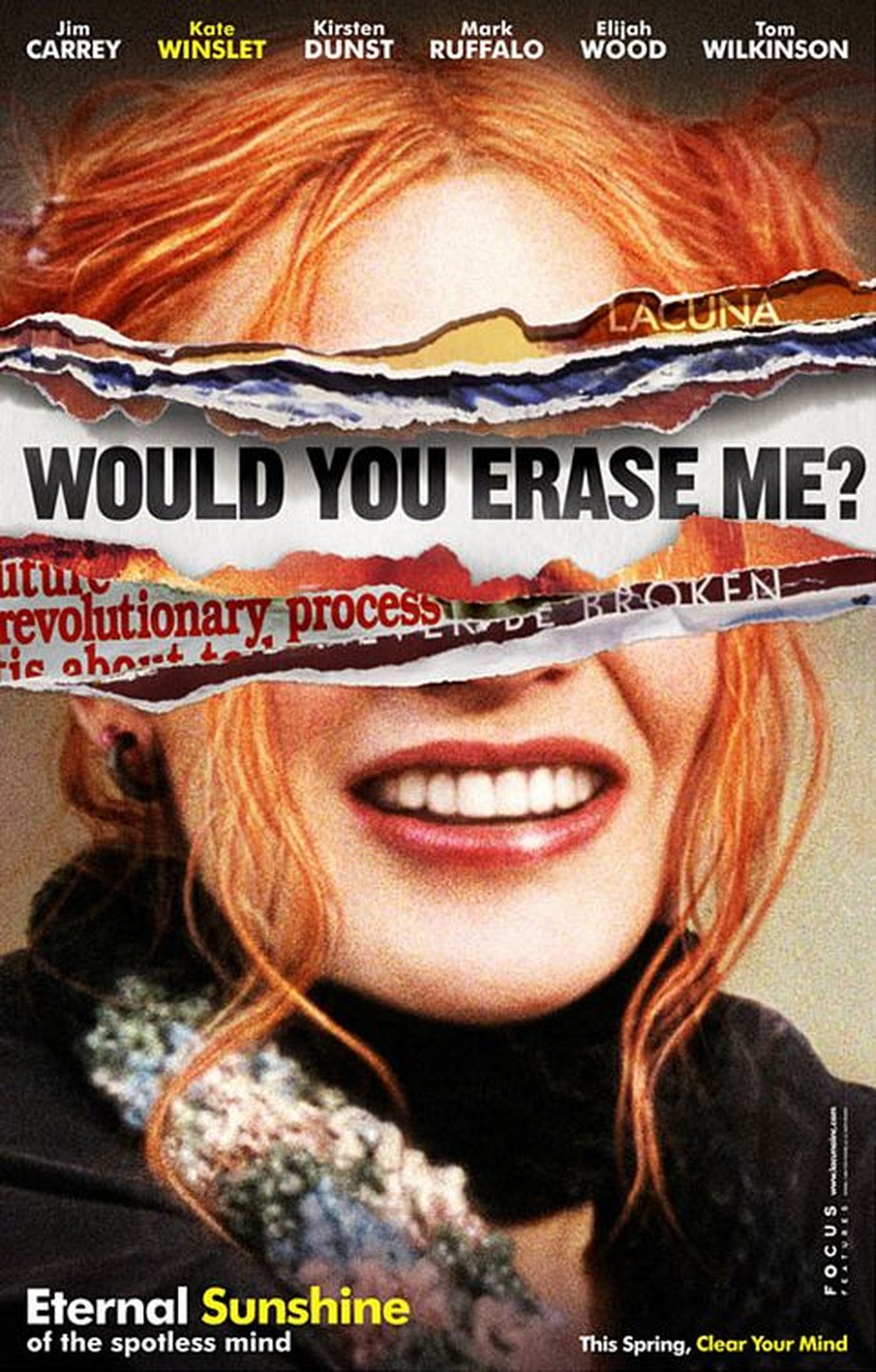
  • Eternal Sunshine of the Spotless Mind

    Eternal Sunshine of the Spotless Mind

    The Scene — Screen

    Most love stories ask whether two people will come together. Eternal Sunshine of the Spotless Mind asks something stranger and sadder: if you could have a love erased from your mind entirely — every memory of it, the good with the bad — would you do it? And if you did, would it stay erased?

    Michel Gondry’s 2004 film, written by Charlie Kaufman, follows Joel (Jim Carrey) who, learning that his ex-girlfriend Clementine (Kate Winslet) has had him erased from her memory, decides to do the same to her. The film then takes us inside his head during the procedure — and watches him change his mind, mid-erasure, and try desperately to hide what is left of her somewhere the process cannot reach.

    WHAT IT GETS RIGHT

    It understands that you cannot keep only the good parts. As Joel’s memories of Clementine are deleted in reverse — from the bitter end back toward the bright beginning — he reaches the early days, the falling-in-love, and realizes too late that those are going too. The film’s whole ache is in that: the painful memories and the precious ones are the same memories. Erase one and you lose both.

    Gondry films the inside of a mind with practical effects and dream logic — houses collapsing, faces blurring, a memory dismantling itself around the man standing in it. It should feel gimmicky and instead it feels exactly true, because that is how memory does behave: partial, melting, defended.

    MEET ME IN MONTAUK

    The film’s final move is its bravest. Joel and Clementine, freshly erased, meet again — and are handed proof of how badly it ended the first time. And they choose each other anyway, eyes open, knowing. It is not a film that says love conquers all. It is a film that says love is worth it even when you know the cost, and that a memory — even a painful one — is not something to throw away.

    Watch it when you are willing to feel hopeful and heartbroken at once. Few films have ever been this clever and this warm in the same breath.

    Pair it with our Date Night guide: The Photo Album Evening.


    POUR — Something to sip slowly while the film rearranges you.

    MOOD — Aching. Inventive. Hopeful, against the odds.

    Worth owning, not just streaming. Find it on Blu-ray.

  • The Age of Innocence

    The Age of Innocence

    The Scene — Screen

    Martin Scorsese has said The Age of Innocence is the most violent film he ever made, and there is not a single act of violence in it. The cruelty is all in the manners — in the smiles, the dinner invitations, the perfectly polite sentences that close a life like a trap.

    Adapted from Edith Wharton’s novel and released in 1993, the film moves through the drawing rooms of 1870s New York high society. Newland Archer (Daniel Day-Lewis) is engaged to the proper, conventional May Welland (Winona Ryder) when he meets her cousin, the Countess Ellen Olenska (Michelle Pfeiffer) — unconventional, separated from her husband, and the first person who has ever made Archer’s settled future feel like a cage.

    WHAT IT GETS RIGHT

    It understands that a closed society does not need to raise its voice to destroy you. Everyone in Archer’s world knows about his feeling for Ellen. Nobody mentions it. Instead they manage it — with a seating plan, a sympathetic word, a farewell dinner thrown with such warmth that Archer only realizes much later he was being quietly, permanently put in his place. The kindness is the weapon.

    Scorsese shoots it like a man documenting a vanished tribe — the food, the flowers, the calling cards, the rules — because the rules are the real subject. Day-Lewis plays a man slowly understanding that his life has been decided for him by people too well-mannered to ever say so.

    THE LIFE NOT LIVED

    What lingers is the ending — an older Archer, given at last a free and easy chance at the love he gave up, and choosing not to climb the stairs. It is the saddest kind of restraint: not the love denied by circumstance, but the love a man can no longer quite imagine himself living. A quiet, devastating film about the cost of belonging.

    Watch it when you can sit with something elegant and merciless. There is no blood in it, and it cuts deeper than most films that are full of it.

    Make an evening of it with our Date Night watchlist: Films of Old New York.


    POUR — Something old and formal. A sherry, a fine red, a cold martini.

    MOOD — Elegant. Merciless. Mannered to the bone.

    Some films belong on the shelf. Find it on Blu-ray.

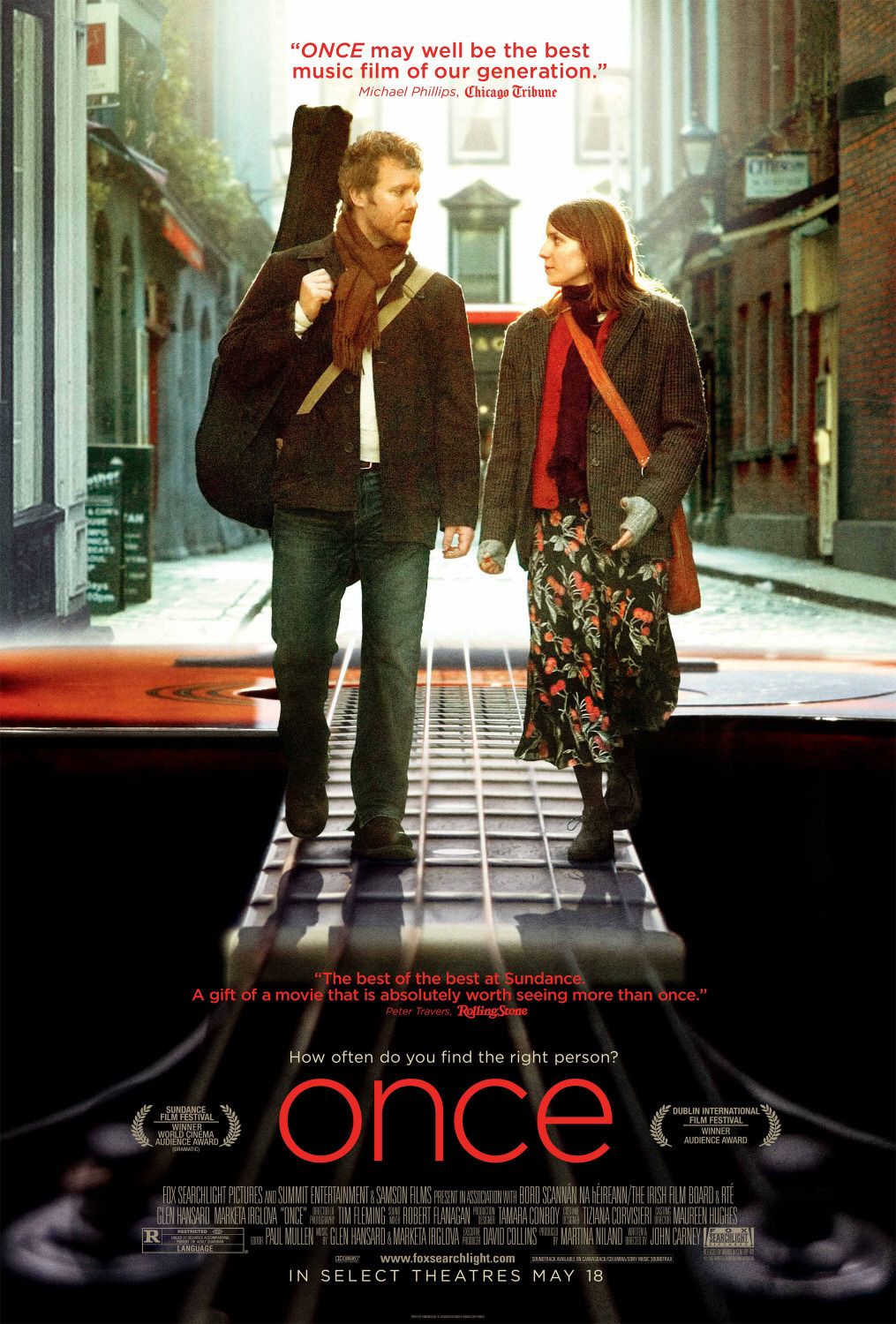
  • Once

    Once

    The Scene — Screen

    Most musicals use songs to interrupt life — the story stops, the number happens, the story resumes. Once does the opposite. In John Carney’s 2007 film, the music is the life. The songs are not performances dropped into the plot; they are the plot, the way these two people actually speak to each other.

    Made for almost no money on the streets of Dublin, the film follows an unnamed busker and an unnamed Czech pianist over the course of a single week. He fixes vacuum cleaners and sings on Grafton Street. She sells flowers and plays piano in a shop because she cannot afford one of her own. They meet, and they begin, tentatively, to make music together.

    WHAT IT GETS RIGHT

    It is honest about what is actually possible. This is not a film where music solves everything and the couple rides off together. Once is about a connection that is real, and creative, and deep — and also bounded, by other commitments, other lives, other people already loved. The film respects that boundary instead of wishing it away.

    And the music is extraordinary because it is unforced. Glen Hansard and Markéta Irglová, real musicians playing close to themselves, perform the songs almost live, in long takes, in real rooms. The famous scene in the music shop — two near-strangers finding a song together for the first time — is one of the truest depictions of connection put on film, and not a word of it is dialogue.

    THE WEEK, AND THE RECORD

    What lingers is the film’s modesty. It promises only what a week can hold — a handful of songs, a recording made, two people changed and then, gently, returned to their separate lives. The gift they give each other is not a future. It is the record. And the film is wise enough to know that is enormous.

    Watch it when you want something small, true, and quietly hopeful. Then play the soundtrack, which is the film’s other half.

    Spend an evening with its music — our Date Night guide: The Soundtrack Evening.


    POUR — A pint, slow, in honor of Dublin.

    MOOD — Tender. Unforced. Hopeful within limits.

    Worth owning, not just streaming. Find it on Blu-ray.

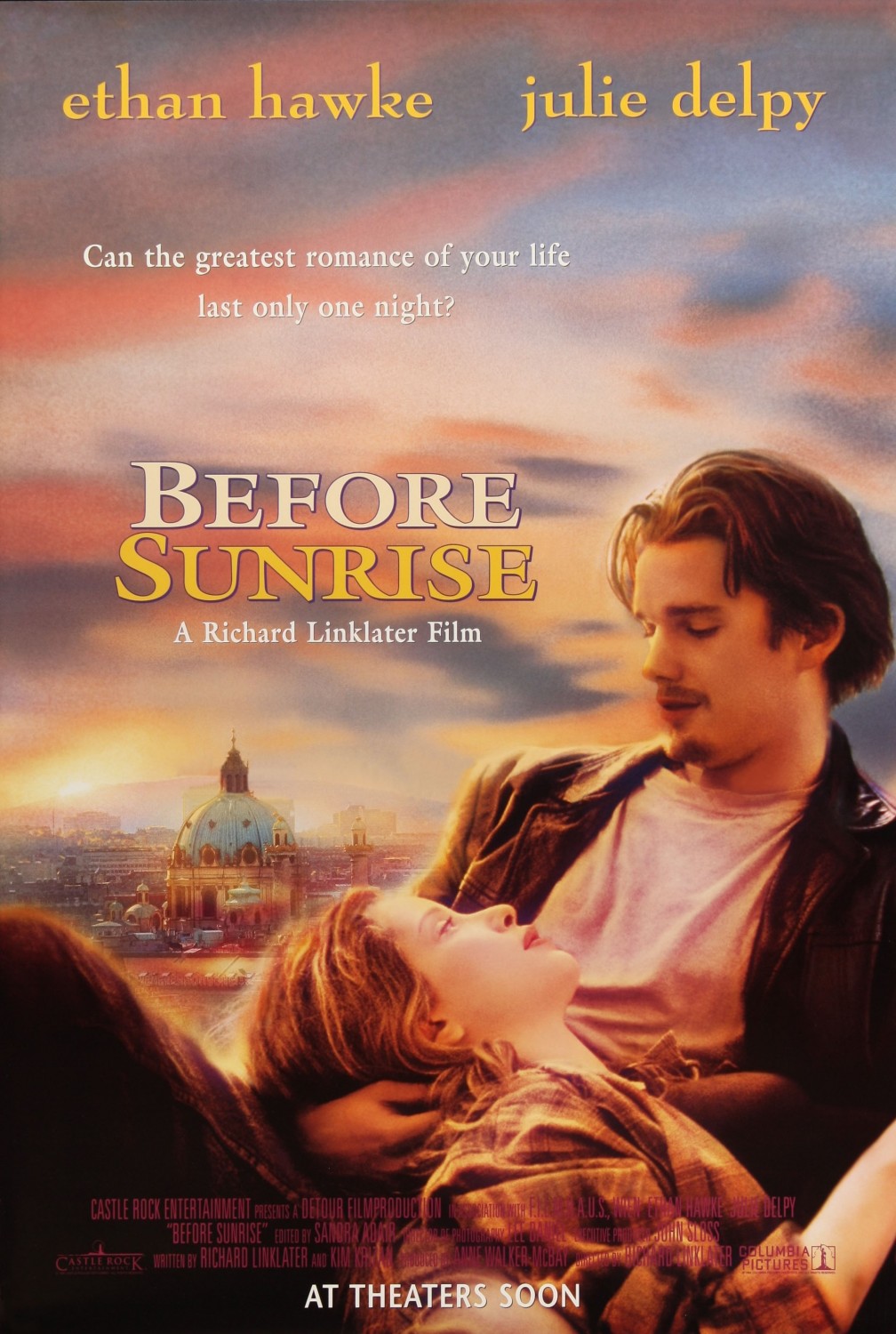
  • Before Sunrise

    Before Sunrise

    The Scene — Screen

    Most romances are built from events — meetings, obstacles, gestures, the architecture of plot. Before Sunrise is built from almost nothing but talk, and it remains one of the most romantic films ever made. The whole movie is two people walking and talking through one city for one night, and it is riveting.

    Richard Linklater’s 1995 film puts Jesse and Céline — Ethan Hawke and Julie Delpy — on a train, then off it together in Vienna, with the clock already running: his flight is in the morning. They have one night. They decide, more or less on a whim, to spend it together. And then the film simply follows the conversation.

    WHAT IT GETS RIGHT

    It understands that talk is courtship. The film has no chases and no crises; it has a long exchange that begins as bright, slightly performed banter and slowly becomes something more honest and more exposed. You watch two people decide to trust each other in real time, sentence by sentence, and the deciding is the drama.

    And it understands the deadline. Every minute of the night is shadowed by the morning. The clock does not create false urgency — it creates a kind of clarity. Knowing the night must end makes both of them braver, more present, more willing to say the true thing. The limit is the engine.

    THE NIGHT, AND THE MORNING

    What lingers is the film’s faith that a conversation can be enough — that you do not need spectacle to render falling for someone, only attention, two good actors, and a city to walk. Vienna becomes a third character, but the film is really just the talk, and the talk is everything.

    Watch it when you want to remember that connection is mostly conversation. Few films have ever trusted that idea so completely, or rewarded the trust so fully.

    Try it yourself with our Date Night guide: The Walking Date.


    POUR — A glass of red in a small bar, the way they do.

    MOOD — Talkative. Awake. Aware of the clock.

    Some films belong on the shelf. Find it on Blu-ray.

  • The Remains of the Day

    The Remains of the Day

    The Scene — Screen

    There is a kind of heartbreak that comes not from loss but from restraint — from a love that was possible, and present, and simply never allowed to be spoken. The Remains of the Day is the definitive film about that particular grief.

    Merchant Ivory’s 1993 film, adapted from Kazuo Ishiguro’s Booker-winning novel, gives us Stevens, the butler of a great English house, and Miss Kenton, its housekeeper. Anthony Hopkins and Emma Thompson play two people who spend years within feet of each other, plainly suited, and never once say the thing that both of them know.

    WHAT IT GETS RIGHT

    The film understands that Stevens’s tragedy is not that he fails to win Miss Kenton. It is that he has built an entire self out of restraint — has made dignity and duty into a fortress — and the fortress works exactly as designed. It keeps everything out, including the one thing he wanted in.

    Hopkins gives a performance almost entirely in the negative — in the words not said, the door not opened, the feeling visibly held just beneath a perfectly composed face. You watch a man decline his own life politely, course by course, and the politeness is the horror.

    THE LETTER, THE RAIN

    It is, fittingly, a slow and quiet film — Ishiguro readers from our Library reading list will recognize the exact register. The famous late scene, two aging people parting at a bus stop in the rain, lands so hard precisely because the film spent two hours teaching you to read silence. By the end you can hear everything Stevens cannot say.

    Watch it when you can sit with something sad and beautifully made. It is a masterpiece of the unspoken, and a quiet warning about the cost of holding too much in.

    Make an evening of it with our Date Night watchlist: Films of Quiet Restraint.


    POUR — Tea, formal, in a proper cup. Sherry, if the ending asks.

    MOOD — Restrained. Aching. Heavy with the unsaid.

    The kind of film that rewards a second viewing. Find it on Blu-ray.

    More from The Scene