
Watching

Films, shows, and live performance — evenings built around what you are seeing.

  • The Double Feature

    The Double Feature

    Shape: two films back to back, with a real intermission between. Plan for four hours and a late night.

    Anyone can watch a movie. The double feature is a commitment — a whole evening surrendered to the couch, two films chosen to talk to each other, with an intermission in the middle that you build yourselves. It is the difference between watching something and making a night of it.

    The pairing is everything. Resist the urge to watch two of the same; a double feature works on contrast or conversation. Pair a film with its director’s later work and watch them age in real time. Pair a loud one with a quiet one so the second feels like an exhale. Or pair two films that share a city, an actor, a year, and let the rhyme reveal itself somewhere in the second hour.

    Honor the intermission. This is the part that separates a double feature from simply not going to bed. When the first film ends, get up. Refill something, raise the lights, take the ten minutes to actually talk about what you just watched before the next one washes it away. The intermission is where the date lives — the movies are just what you do around it.

    Build the room for the long haul: blankets within reach, the snacks pre-positioned so no one has to fully leave, the phones face-down in another room entirely. A double feature is a small endurance event, and like any endurance event it rewards preparation and punishes the half-committed.

    Make It Yours

    The best double bills are personal, not prestigious. Two films one of you loves and the other has never seen will always beat two films you both feel you ought to watch. Let it run late. That second movie, watched past your bedtime, is the one you will both remember.

  • The Quiet Film

    The Quiet Film

    Date Night — Watching

    The default film night reaches for something with momentum — a thriller, a big comedy, something that fills the room and carries you. There is nothing wrong with that. But there is a different kind of film night worth trying: the quiet film. No spectacle, no propulsion, no score telling you how to feel. A film that simply asks for your attention and rewards it.

    WHY QUIET IS HARDER, AND BETTER

    A loud film does the work for you. A quiet film hands some of the work back — you have to lean in, notice, sit with a long take, read a face instead of a plot. That sounds like effort, and it is, a little. But effort shared is its own kind of closeness. Two people paying real, undistracted attention to the same quiet thing are doing something genuinely together.

    The quiet film also leaves room. A loud film fills every second; a quiet one has space in it — pauses, stillness, scenes that breathe. And in that space, a date can exist. You feel each other’s reactions more. The silence on screen makes room for the small shared glance, the hand found in the dark.

    HOW TO DO IT

    This is the one film night where the setup genuinely matters. Phones away, properly away — a quiet film cannot survive a divided room. Lights fully down. No second screen, no half-watching. Choose something unhurried and character-driven, and commit to it together.

    It is the same principle as a stripped-down acoustic set — take away the noise and the spectacle, and what is left has to be real. A quiet film, watched properly, is a small act of shared attention. That attention is the date.

    More on the live recording in The Scene: MTV Unplugged in New York — Nirvana.


    POUR — One glass of wine, sipped slowly. Nothing that needs refilling.

    MOOD — Still. Attentive. Leaning in together.

  • Films of Old New York

    Films of Old New York

    Date Night — Watching

    There is a particular pleasure in watching a film set in a New York that no longer exists — the city of horse carriages, or of jazz clubs, or of a skyline missing half its towers. It is time travel with a love story attached, and it makes a fine evening in. A watchlist for a night spent in the city’s past.

    THE AGE OF INNOCENCE (1993)

    Scorsese’s 1870s New York — all gaslight, drawing rooms, and the slow cruelty of good manners. A city of rules, rendered with documentary care, and a love story crushed beneath them.

    MANHATTAN (1979)

    Woody Allen’s black-and-white valentine to the city, opening on a skyline and a rhapsody. A New York of bookshops and bridges and complicated affection, shot like a place worth loving.

    ONCE UPON A TIME IN AMERICA (1984)

    Sergio Leone’s sprawling, mournful epic of immigrant New York across decades — the Lower East Side as a place of memory, loyalty, and irreversible loss.

    BROOKLYN (2015)

    The 1950s city seen through the eyes of a young Irish immigrant — boarding houses, department stores, a New York that is strange and then, slowly, home. (Reviewed in our Scene pages.)

    Pick one, pour something, and spend the evening in a New York you can only reach through a screen. The city keeps all its old versions, if you know where to look.

    Read the full film review in The Scene: The Age of Innocence.


    POUR — Something the era would recognize. A martini, an old fashioned.

    MOOD — Nostalgic. Transported. In a city that was.

  • The Documentary Night

    The Documentary Night

    Date Night — Watching

    The default date-night film is fiction — a story, a romance, a thriller. The documentary rarely makes the shortlist, and that is a small mistake. A good documentary is one of the best things two people can watch together, because it does not just fill the evening. It hands you the conversation that follows it.

    WHY IT WORKS AS A DATE

    A drama tends to end in a feeling — you sit with it, maybe say that was good, and move on. A documentary ends in a subject. You finish it knowing something you did not know two hours ago, and so does the person beside you, and now you both have it. The film becomes a thing to think out loud about together rather than just a thing you watched.

    It is also a small act of mutual curiosity. Choosing a documentary on a topic neither of you knows well is a way of saying let us go and learn something together — and being curious side by side is its own quiet form of intimacy.

    HOW TO DO IT

    Pick a subject, not a title — agree on something you are both faintly curious about and find the documentary from there. Music documentaries are an easy, reliable entry point; so are ones about food, design, the natural world, a single strange history. Keep the lights low like any film night. And leave room afterward — do not start something else right away. The conversation is the second feature.

    A documentary date is a film and a seminar and a conversation, all for the price of one evening in. Choose one this week.

    More on the live recording in The Scene: At Folsom Prison — Johnny Cash.


    POUR — A drink to suit the subject. A whiskey for the music ones.

    MOOD — Curious. Engaged. Still talking after the credits.

  • Films of Quiet Restraint

    Films of Quiet Restraint

    Date Night — Watching

    Some films shout their love stories. These do not. They are built on restraint — on glances, pauses, the things characters almost say and then do not — and they ask the viewer to lean in and do some of the work. Watched with the right person, that leaning-in is the whole pleasure.

    A watchlist for an evening that wants to feel a great deal while almost nothing is said.

    THE REMAINS OF THE DAY (1993)

    The standard for the form. A butler and a housekeeper, years of unspoken feeling, and a final parting in the rain that lands like a held breath finally released.

    IN THE MOOD FOR LOVE (2000)

    Two neighbors, a love affair they refuse to begin, and Wong Kar-wai turning every corridor and clock into longing. Restraint shot like a fever.

    LOST IN TRANSLATION (2003)

    A few days, a quiet hotel, and a connection neither names. The unheard whisper at the end is the film keeping its own counsel — and trusting you to.

    PORTRAIT OF A LADY ON FIRE (2019)

    A painter, her subject, and a love conducted mostly in looks across a room. A film that understands restraint and desire are the same heat at different temperatures.

    Pick one. Pour something quiet. Let the silences do the talking — and let the two of you fill them in afterward.

    Read the full film review in The Scene: The Remains of the Day.


    POUR — A glass of wine, red, sipped slowly through the quiet.

    MOOD — Hushed. Attentive. Leaning in.

  • The Concert Film Night

    The Concert Film Night

    Date Night — Watching

    Not every night can be a night out. But the feeling of a night out — the volume, the lights, the shared lift of live music — does not have to stay at the venue. The concert film night brings it home, and done right it is one of the best low-effort dates there is.

    SET IT UP LIKE A SHOW

    The mistake is to watch a concert film like an ordinary movie — half-attention, lights on, phone nearby. Treat it like the show it is filming. Lights down. Volume up, genuinely up, as loud as the neighbors allow. Stand if the film earns it. The concert film rewards being met halfway.

    Pour something you would actually drink at the venue — a beer, a whiskey, nothing fussy. Keep the snacks simple. The point is the room becoming, for ninety minutes, a small private show with a crowd of two.

    WHAT TO PUT ON

    Pick a film that was made with care — one that gets close to the band rather than just pointing a camera at the stage. The Last Waltz is the gold standard: Scorsese’s film of The Band’s farewell concert, a show and an ending and a party all at once, built to be watched loud and late.

    Two people, the lights down, a great show playing like it is happening tonight. The venue can wait. Bring it home instead.

    Read the full review in The Scene: The Last Waltz.


    POUR — Whatever you would order at the bar. A beer, cold.

    MOOD — Loud. Lifted. On your feet by the encore.

  • Watching Brooklyn Together

    Watching Brooklyn Together

    Date Night — Watching

    Brooklyn is a gentle film with a quietly enormous question at its center: what is home, and what does it cost to choose one. It is a good film to watch beside someone you are building something with, because it puts that question softly on the table without ever raising its voice.

    THE EVENING

    This is a Sunday film, not a Friday one. It moves at the pace of letters crossing an ocean. Give it an unhurried evening — dinner already finished, the dishes done, nowhere to be after the credits.

    If you want to lean into it, make the meal Irish-adjacent or Italian-American — the film lives between those two kitchens, and there is something fitting about eating from one of Eilis’s two worlds before watching her choose between them.

    WHAT IT WILL OPEN UP

    Afterward, you may find yourselves talking about home — where yours is, whether it is the place you came from or the place you are making, whether you have ever had to choose. It is a kinder conversation than it sounds, and a good one to have early.

    For the full review, see our Scene write-up of Brooklyn. For tonight, it is enough to pour the tea, start the film, and let its quiet question sit gently between you.

    Read the full film review in The Scene: Brooklyn.


    POUR — Tea with milk, two cups. A small whiskey for the ending.

    MOOD — Tender. Reflective. Talking softly after.

  • The Four-Day Romance

    The Four-Day Romance

    Date Night — Watching

    There is a whole genre built on a small idea: that a love story does not need a lifetime to be complete. It needs a few days, a clear ending, and two people who know the clock is running. The brief encounter — the romance with a deadline built in.

    A watchlist for an evening that wants to feel something and then let it go.

    BRIEF ENCOUNTER (1945)

    The original and still the standard. Two strangers, a train station, a love that never gets the chance to become ordinary. David Lean made restraint feel like a thunderstorm.

    BEFORE SUNRISE (1995)

    One night in Vienna, two strangers, and a conversation that becomes the whole relationship. The deadline — his flight, her train — is the engine of every scene.

    LOST IN TRANSLATION (2003)

    A few days in a Tokyo hotel between two people who needed exactly each other and exactly then. What he whispers at the end stays unheard, and the film is better for it.

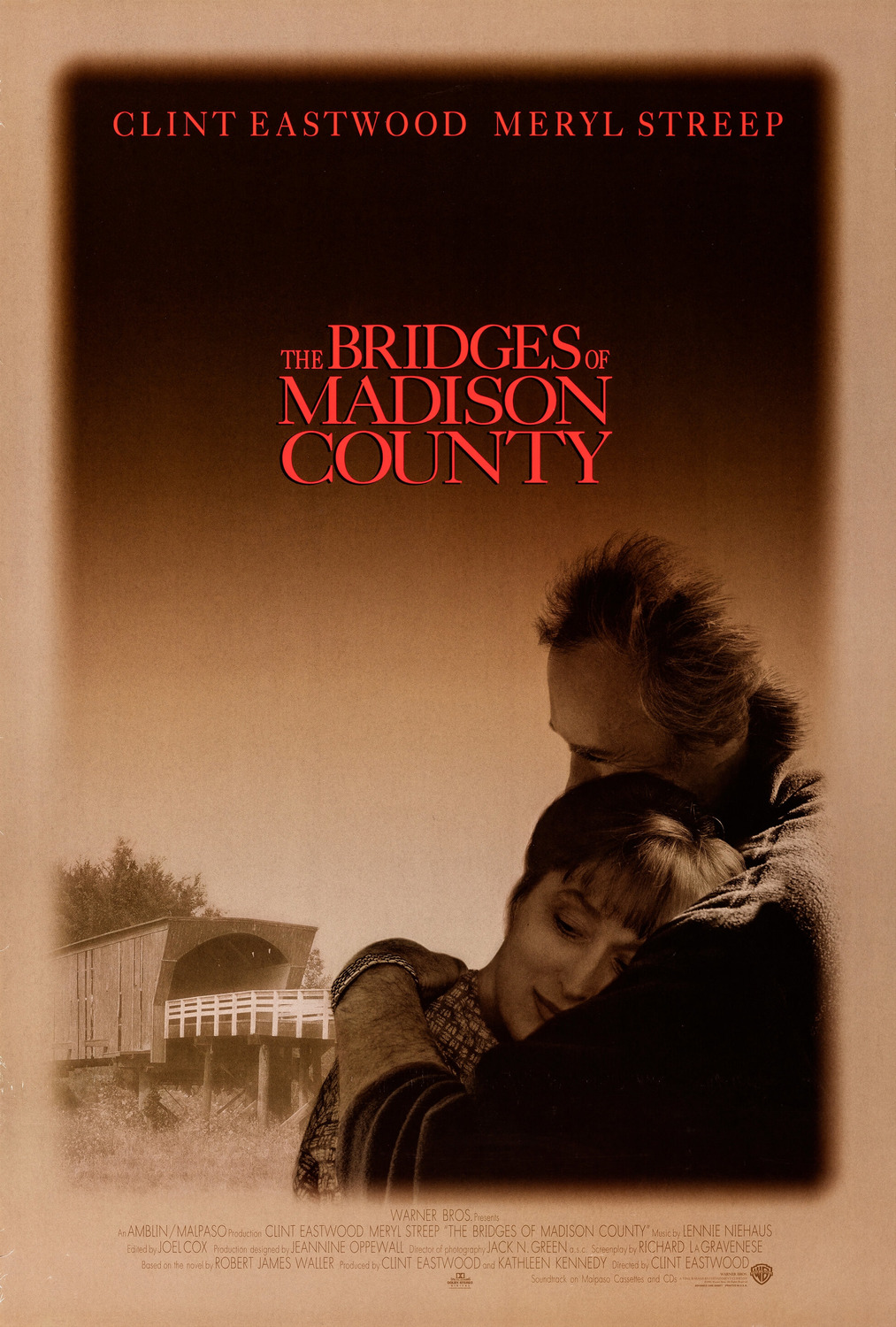
    THE BRIDGES OF MADISON COUNTY (1995)

    Four days in an Iowa kitchen, and then a lifetime of carrying it. The brief encounter taken to its furthest, hardest conclusion — what you do with the love after the four days end.

    Pick one. Pour something. Let the deadline do its work — and let the credits be the ending, the way the films intend.


    POUR — Something with an ending in mind. A single glass of wine.

    MOOD — Bittersweet. Tender. Willing to let it go.

  • Watching The Bridges of Madison County Together

    Watching The Bridges of Madison County Together

    Date Night — Watching

    Some films you watch alone, to feel something privately. The Bridges of Madison County is better watched beside someone — not because it is comfortable, but because it is not.

    This is a film about a road not taken, and watching it together is a quiet act of confidence. It says: we can sit with a story about wanting something other than the life you chose, and the wanting will not frighten us.

    THE EVENING

    Make it unhurried. This is not a Friday-night-energy film. It wants a Sunday, a slow dinner finished early, the dishes already done. Iowa in 1965 moves at the pace of a hot afternoon, and the evening around the film should match it.

    Cook something plain and good beforehand — the film practically lives in Francesca’s kitchen, and there is something right about eating a simple home meal before watching one become the center of a love story.

    WHAT IT WILL DO

    It will get quiet near the end. The famous scene — the rain, the truck, the traffic light — does not invite commentary. Let it sit. The conversation worth having is the one that comes afterward, on the couch, in no hurry: what you would carry, what you would choose, what you are glad you did.

    For the full review of the film itself, see our Scene write-up. For tonight, it is enough to pour something slow and let the four days play out beside the person you did choose.

    Read the full film review in The Scene: The Bridges of Madison County.


    POUR — Whiskey, neat, two glasses. A pot of coffee for after.

    MOOD — Tender. Honest. Closer by the credits.

  • The Art Film

    The Art Film

    Two hours for the film. Another hour, at minimum, for what comes after.

    The art film as a date works precisely because it asks something of you. You can’t coast through it. You have to pay attention, decide how you feel about what you’re seeing, and then — this is the part most people skip — actually talk about it afterward with the person next to you.

    The after-conversation is the date. The film is the premise.

    Pick something with a point of view. Not deliberately difficult, not obscure for the sake of obscure — something made with intention that leaves room for interpretation. The films that work best for this are the ones where two people can watch the same scene and come away with genuinely different readings. That’s the raw material for the conversation you want to be having at eleven o’clock over a drink you weren’t expecting to have.

    Seek out the independent cinema in your city rather than the multiplex. The projection tends to be better. The crowd is quieter. And the repertory theaters that screen classic and international cinema create a specific atmosphere — the sense that you’re there to actually watch, not just to say you did (tickets run $14–18 at most independent houses, less for matinees). Some cities have theaters that pair films with wine or cocktails; those are worth seeking out specifically.

    Sit toward the middle. Don’t talk during the film. Don’t check your phone. Let the thing actually happen to you.

    Afterward, don’t go straight to the car. Find a bar or a coffee place near the theater and sit down. The conversation needs a room. Some combination of: what did you actually think, was there a moment that got to you, what did you think it meant, what did it make you think about that has nothing to do with the film at all. The best version of this conversation will drift away from the movie within twenty minutes and end up somewhere neither of you expected.

    Find your local equivalent

    Search your city plus “repertory cinema,” “art house,” or “independent film.” Most cities with a university have at least one. The Criterion Channel and MUBI are good sources for the same experience at home if there’s nothing nearby — pick something together, make the room for it properly, treat it like you’d treat going out.

    Where to start

    The Film Forum in New York and the Cinematheque in Los Angeles are the gold standards. The Music Box in Chicago. The Alamo Drafthouse does repertory programming at several locations nationally and gets the experience right. For a weekend road trip version: the Brattle Theatre in Cambridge has been programming seriously for decades. If you’re choosing at home, pick something from the Criterion Collection that neither of you has seen. Trust the selection.

    watching  ·  going-out  ·  any-stage  ·  cinema  ·  art-house  ·  conversation  ·  evening  ·  drinks-after  ·  intentional  ·  independent