Listening

Concerts, intimate venues, and music that holds an evening together.

  • The Italian Records

    The Italian Records

    Date Night — Listening

    Here is a listening evening with a single, transporting theme: Italy. Spend a night with the music of one country — the film scores, the old standards, the lounge records — and let the sound do what a plane ticket would, for the price of an evening in.

    WHY A COUNTRY MAKES A GOOD THEME

    A themed listening evening gives the night a shape and a destination, and a country is the easiest, richest theme there is. Choose Italy and you have an enormous, varied songbook to draw from — and a coherent mood running underneath all of it. The room becomes, for an evening, somewhere else.

    It also turns listening into a small act of travel you take together. You are not just playing records; you are choosing a place and going there for a few hours, side by side. The music is the journey, and you are each other’s company on it.

    WHAT TO PLAY

    Italy offers more than enough. The lush, swooning film scores of the great Italian composers — the music of Fellini’s Rome especially, all sweetness and shadow. The mid-century standards, the crooners, the sound of a Roman cafe in 1960. Modern Italian songwriters, if you want to bring it forward. Build a sequence that drifts across decades but never leaves the country.

    Pour something Italian to match — a negroni, a glass of something from the right hills — and let the evening become a holiday. If you want the film to go with it, Roman Holiday is waiting in our Scene pages. Tonight, just let the records carry you there.

    More on the film in The Scene: Roman Holiday.


    POUR — A negroni, or an Italian red. Stay in country.

    MOOD — Transported. Sun-warmed. Somewhere near Rome.
  • The Debut Album

    The Debut Album

    Date Night — Listening

    Here is a theme for a listening evening: debut albums. Not greatest hits, not the acclaimed third record where everything came together — the first one. The sound of a band before they knew who they were, captured with all the nerve and roughness still on it.

    WHY DEBUTS ARE DIFFERENT

    A first album has a particular quality you cannot fake and cannot get back. The band has nothing to live up to, no audience expectation to manage, often no real money and no time. What they have instead is everything they have been saving — years of ideas poured into one record because they may not get to make a second.

    Debuts are often rawer, stranger, less polished than what came later — and frequently more thrilling for exactly that reason. You can hear the band reaching past what they can quite do yet. You can hear them not knowing the rules they would later learn. Sometimes the not-knowing is the magic.

    HOW TO MAKE AN EVENING OF IT

    Each of you picks a debut album — by a band you love, or by one neither of you knows — and you play them back to back, properly, start to finish. Then talk about it: what is already there on the first record, what they had not figured out yet, what was lost as well as gained when they got slick.

    A perfect one to anchor the evening: The Velvet Underground & Nico — a first album so fully itself, so unbothered by what anyone wanted, that bands are still catching up to it. Start there, and listen for the sound of a band inventing itself in real time.

    More on the record itself in The Scene: The Velvet Underground & Nico.


    POUR — A Manhattan each, made to last the first record.

    MOOD — Curious. A little raw. Hearing first drafts.

  • The Soundtrack Evening

    The Soundtrack Evening

    Date Night — Listening

    Here is a small, particular date: put on the soundtrack to a film you both love, and do not watch the film. Just play the music — the score, the songs, the record the movie left behind — and let it run while you do something else, or nothing else, together.

    WHY IT WORKS

    A soundtrack you both know is a strange and lovely object. It is music, but it is also memory — every track is wired to a scene, a feeling, the night you first saw the film, perhaps the night you saw it together. Playing it is a way of revisiting all of that without sitting through the movie. The music carries the whole story in compressed form.

    And it makes a perfect evening’s background precisely because you both already know it. There is no learning curve, no one track that pulls focus — just a familiar emotional landscape filling the room. You can talk over it, cook to it, sit in it. The soundtrack sets a mood you have both already agreed to love.

    WHAT TO PLAY

    Choose a film whose music genuinely stands on its own — and the films about music are the natural place to start, where the songs were the point. Once is close to the ideal case: a small film whose soundtrack is so complete, so much its own record, that an evening spent inside it feels like the film distilled to its essence.

    Pour something, put it on, and let the music play the film back to you both — quietly, in the background, all evening.

    More on the film in The Scene: Once.


    POUR — A glass of wine, the soundtrack already playing.

    MOOD — Familiar. Warm. Scored by something you both love.

  • The Headphone Hour

    The Headphone Hour

    Date Night — Listening

    Here is a small, strange, very good date: two people, one album, two pairs of headphones, the same room. You press play at the same moment and then you do not speak. For the length of a record, you are listening to the exact same thing, alone, together.

    WHY IT IS DIFFERENT

    Speakers fill a room — the music becomes the shared air, and you talk over it, around it, through it. Headphones do the opposite. They put the music inside you. The sound is close and private and detailed in a way no room playback can match. You hear the breath before the vocal, the fingers on the strings.

    Doing that beside someone, on the same record, at the same time, is a quietly intimate thing. You are each having a private experience — and you are having the identical private experience, in sync, knowing the other person is somewhere inside the same sound. When the record ends and you take the headphones off, you have something exact to talk about.

    HOW TO DO IT

    Pick a record worth the detail — something richly produced, something that rewards hearing the small things. A jazz record is close to ideal; an album like Coltrane’s A Love Supreme reveals layers on headphones that speakers simply blur. Sit comfortably. Press play together. Do not talk until it ends.

    Then take them off, and compare the hour. You will find you each heard a slightly different record — and that difference is the conversation.

    More on the record itself in The Scene: A Love Supreme — John Coltrane.


    POUR — One drink each, set down within reach before you start.

    MOOD — Close. Interior. Synced and silent.

  • The Saturday Record

    The Saturday Record

    Date Night — Listening

    Not every date happens after dark. Some of the best ones happen at ten in the morning, in a kitchen, before either of you has fully decided to be awake — and the whole tone of it can be set by what you reach for first.

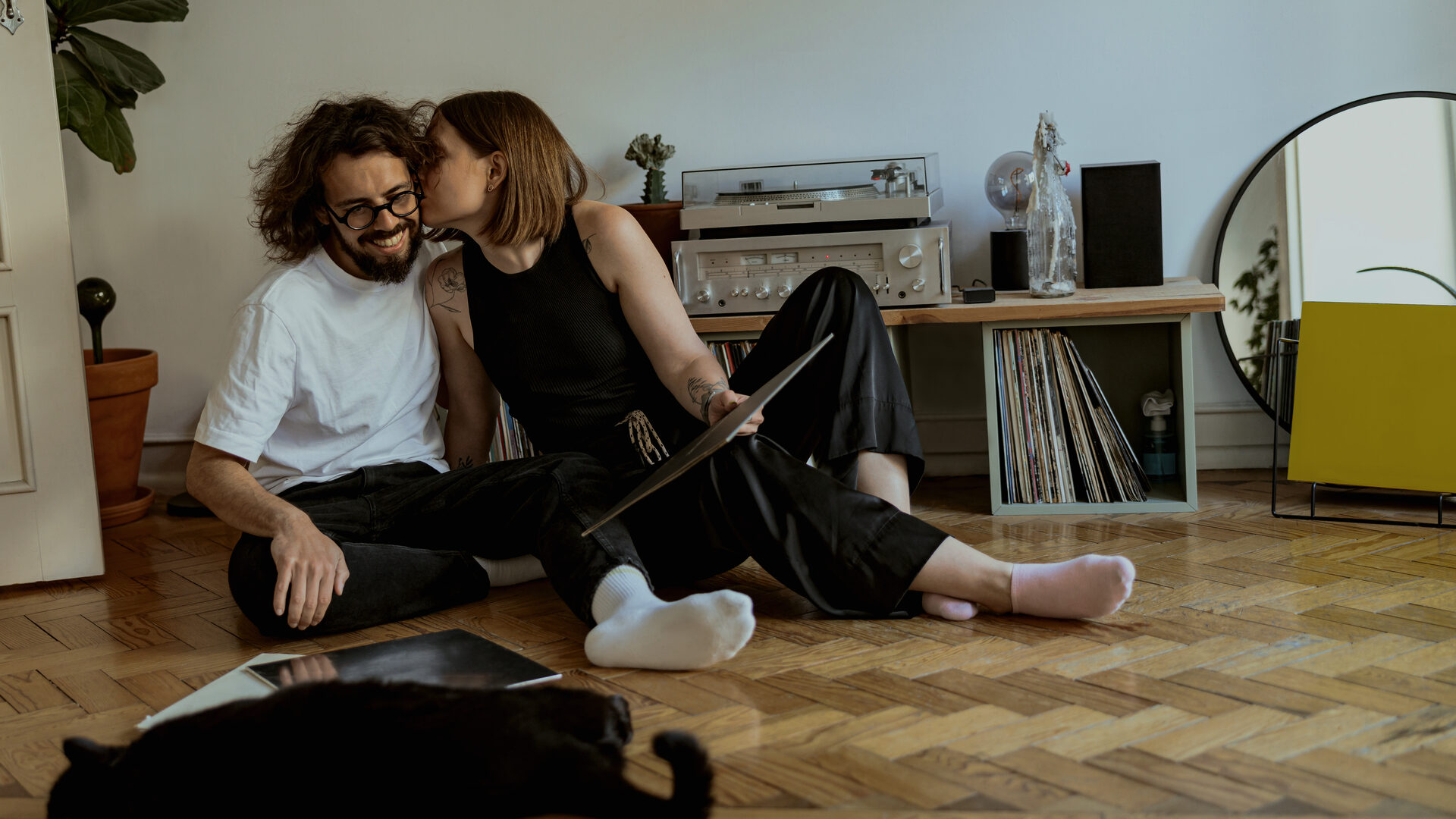
    The Saturday record is a small ritual: the weekend begins not with a phone, not with the news, but with a needle dropped on something good. It is a date in the sense that matters — two people, deliberately, choosing how an hour will feel.

    WHY IT SETS THE DAY

    The first sound of a day has outsized power. A notification starts the day in someone else’s key — urgent, fragmented, already behind. A record starts it in yours. Coffee brewing, something warm playing, no screen yet. The day arrives slowly and on your terms.

    Make it a shared thing. One of you chooses the record this week, the other next. It becomes a small ongoing conversation conducted in music — a way of saying here is the morning I want us to have without having to say it.

    WHAT TO PLAY

    Saturday morning is not the hour for anything demanding. Reach for something warm and unhurried — a soul record, a soft jazz album, something that fills the kitchen without asking for your full attention. The record is the background the morning is built on, not the event.

    Coffee, a record, and no hurry. It is the gentlest date on this site, and it makes every Saturday slightly better than it would have been.


    POUR — Coffee, a full pot, the good cups.

    MOOD — Slow. Warm. The weekend in the right key.

  • The Album in Full

    The Album in Full

    Date Night — Listening

    We have mostly stopped listening to albums. We listen to songs, shuffled, while doing something else. The idea of putting on one record and hearing it through, in order, with nothing else happening, has quietly become a radical act.

    Make it a date. Not music as the backdrop to a date — the listening itself as the evening.

    HOW IT WORKS

    One of you chooses a record. Something with a shape — an album built to be heard in sequence, where the order is an argument the artist is making. You sit down. You do not reach for a phone. You let side one become side two.

    Forty minutes of shared attention to the same thing, at the same time, is rarer than it sounds. You are not performing conversation. You are simply both inside the same forty minutes — and afterward you have heard the same thing and can talk about it, or not.

    WHAT TO PLAY

    Pick a record that rewards the format. Something unhurried — a late-night album that was never meant to be broken into singles. Van Morrison’s Astral Weeks is almost the platonic case: forty-seven minutes that only fully works heard whole, in order, in the quiet.

    Two chairs, one record, no second screen. It is the simplest date on this site and quietly one of the best.

    More on the record itself in The Scene: Astral Weeks — Van Morrison.


    POUR — One good drink each, made to last the record.

    MOOD — Still. Attentive. Side one becoming side two.

  • The Album You Put On for Someone Else

    The Album You Put On for Someone Else

    One to two hours · Staying in · Any stage

    There is an intimacy to choosing music for someone else that most people don’t think about. You’re not performing. You’re not filling silence. You’re saying: here is something I want you to hear, something I think you’re ready for, something I’ve been waiting to play for you.

    The setup matters. Don’t announce it. Don’t say “I want you to listen to this.” Just put it on. Pour a drink, sit down, let it start. If it’s the right record and the right moment, they’ll stop whatever they’re doing and let it happen.

    The album has to be complete. Not a playlist, not a shuffle — a record with a beginning and an end, an arc you can feel. Something that takes its time. You’re not entertaining them; you’re giving them somewhere to go for an hour.

    You watch them listen. Not intrusively — you have your own drink, your own quiet. But you notice the moment a song lands. You notice when they look up. You don’t say anything. You let the record do what it came to do.

    Afterward, if the evening is going right, you’ll talk about it. Or you won’t, and that will also be right. Either way, something happened that wouldn’t have happened with the television on.


    A place to start

    If you don’t know what to put on, start with something you know well enough to not be nervous about. Joni Mitchell’s Blue works almost every time. It’s an album that asks nothing of the listener except attention, and it rewards exactly that.


    Find the Record

    Joni Mitchell’s Blue on vinyl. The one worth putting on for someone. This pressing holds up.

    See on Amazon →

    From The Scene → Blue →

  • The Record Store

    The Record Store

    One to two hours. You’re not buying anything. Or maybe you are.

    The record store date is one of the great overlooked formats: inexpensive, unhurried, and quietly revealing in ways that are hard to replicate. You walk in together and immediately separate. You’re in the same room but you each go where your taste takes you. Twenty minutes later one of you walks over to the other holding something, and the conversation begins.

    That walk — holding an album toward someone, watching their face register or not register — is its own kind of shorthand. You learn something. Sometimes you learn several things at once.

    Find a good independent record store. The ones worth going to are easy to identify: the bins are organized but not clinical, there’s something playing that you didn’t expect, and the staff will talk to you about what they’re listening to if you ask. Avoid the ones that feel like museums — you want a place that’s genuinely working, where people come in to buy things, where the listening station is actually on (most cities with a healthy independent music scene have at least one; they tend to cluster near universities and arts neighborhoods).

    Budget for a record each if you can — not an obligation, but the date has a different texture when you both leave with something (new releases run $25–35; used bins are where the interesting finds usually live, often $5–15). The better practice is to buy one record for the other person. Something you think they’d like or something you want them to hear. Hand it over on the way out.

    Afterward: go somewhere and listen to what you found. Even just in the car, even just the first track. Let the thing you picked be heard while you’re still in the same space. The record store date is a good setup for a wine bar or a coffee place nearby where you can keep talking about what you found.

    Find your local equivalent

    Search “[your city] independent record store” — the ones with Yelp reviews mentioning “bins” and “staff picks” are usually the right ones. Record Store Day (first Saturday in April) is a good excuse to go if you haven’t been before. The shops that participate tend to be the ones worth returning to throughout the year.

    Stores that do this well

    Amoeba in Los Angeles and San Francisco is the largest and most overwhelming — give yourself time. Rough Trade in Brooklyn and Chicago is curated and feels deliberate. Criminal Records in Atlanta. Waterloo Records in Austin. Grimey’s in Nashville. Twist & Shout in Denver. If you can’t find something interesting in these stores, you’re not looking in the right bin.

    going-out  ·  listening  ·  any-stage  ·  vinyl  ·  browsing  ·  discovery  ·  affordable  ·  afternoon  ·  neighborhood  ·  gift

  • The Radio Night

    The Radio Night

    One to three hours. You don’t control what comes next.

    Streaming has made music frictionless and in doing so has made it slightly less interesting. You know what you’re going to hear. The algorithm has studied you. Everything is curated toward your known preferences, which means nothing surprises you, which means you never encounter something you didn’t know you needed.

    Late night radio is the opposite of this. You tune in and whoever is on air is playing what they want to play, in the order they want to play it, and you have no input. The constraint is the point. You’re not choosing. You’re just there.

    This works best late — after ten, ideally after eleven, when the programming tends to become more interesting and the hosts tend to play the things they actually want to play rather than the things that are supposed to be on (college radio is the best source for this; every university station has at least one overnight show that is genuinely odd and genuinely good). Find your local college station first. Then explore what streams online.

    Put it on at a reasonable volume — present but not loud. Don’t make it the center of the evening; let it be the background against which the evening happens. The radio is there. You’re also there. The conversation and the music move around each other.

    When something comes on that stops you — a song you’ve never heard, a song you forgot existed, something you didn’t know the other person would react to — say something about it. Or don’t. Sometimes the right response is to just let it play and notice that you’re both listening to the same thing at the same time without saying anything.

    Some late-night stations take requests or dedications by text or email during the show. Sending one — something specific, something honest, something that means something to you both — is a small thing that tends to land larger than it should. Worth doing at least once.

    Find your local equivalent

    Search your city plus “college radio” and look for what streams online. KEXP in Seattle streams internationally and is one of the most respected independent stations in the country. KCRW in Los Angeles and WGBH Jazz in Boston. WWOZ in New Orleans for something with a specific regional character. Any NPR affiliate on weekend evenings tends toward more adventurous programming after nine. The station you find by accident — the one you didn’t know existed before tonight — is usually the best one.

    On dedication requests

    Some late-night shows take requests or dedications by text or email. Sending one — something specific, something honest, something the person across from you doesn’t know you’re sending until the DJ reads it — is a small thing and a large one at the same time. Worth doing at least once.

    listening  ·  staying-in  ·  any-stage  ·  radio  ·  live  ·  late-night  ·  no-screens  ·  serendipity  ·  one-hour  ·  discovery

  • The Headphone Session

    The Headphone Session

    Ninety minutes. One album each. No skipping.

    There’s a particular kind of listening that requires good headphones and the willingness to actually sit still for it. This is that. You each bring one album — something you want the other person to hear in full, in order, the way it was meant — and you listen to it together. Then you talk about it. Then you listen to theirs.

    The rules are simple and they’re the whole point. No shuffling. No skipping. No talking during, except for a hand on an arm if something hits. You listen to the whole thing.

    Get a splitter and a pair of decent headphones each — or one good pair of over-ear headphones and take turns (a Y-splitter runs under $10; the experience is better than speaker playback for this format because it’s more interior, more committed). The physical act of putting headphones on and sharing a cord or a device does something to the dynamic. You’re both inside the same sound at the same time.

    Choose your album with more care than you’d use for a playlist. Pick something you love and want explained — the album where your taste got weird, or the one from your teenage years that you’ve never quite been able to describe to someone, or the one you’ve been listening to on repeat for three weeks and want another person inside of with you. The point is revelation, not performance.

    After each album, before you put on the next: tell the other person one thing. A lyric, a moment, a reason you picked it. Something that costs a little to say. This is the part that turns a music-listening session into something closer to a conversation.

    What you learn about someone from the album they pick is reliable in a way that’s hard to explain. It’s not the same as asking someone about their taste. It’s something else — closer to watching them in a room where they think no one’s paying attention.

    Find your local equivalent

    This one lives anywhere you have a comfortable place to sit and a way to share audio. The gear involved is genuinely minimal. A splitter. Two sets of earbuds or over-ear headphones. A phone or a laptop with Spotify or Apple Music or whatever you both have. That’s the whole setup. The album you pick is where the investment is.

    Some albums that tend to work

    Carole King’s Tapestry holds up in full in a way almost no other record from that era does. Kendrick Lamar’s To Pimp a Butterfly is better listened to straight through than in pieces. Nick Cave’s The Boatman’s Call is about heartbreak in a way that doesn’t feel like a cliché. Radiohead’s OK Computer, still. Whatever album changed how you understood music when you were nineteen: that one. The other person doesn’t need to have heard it before. Actually, it’s better if they haven’t.

    listening  ·  staying-in  ·  any-stage  ·  music  ·  headphones  ·  album  ·  intentional  ·  intimate  ·  revelation  ·  no-screens

    Worth Having · The Headphones

    Sony WH-1000XM5. The noise cancellation is the thing. Put them on and the room disappears. What you hear next is up to you.

    See on Amazon →

    The whole thing hinges on a cheap little splitter. A couple dollars on Amazon.