To every thing there is a season, and a time to every purpose under the heaven: a time to keep silence, and a time to speak.Ecclesiastes 3
He went to Nora straight from the church on Friday, in the dark suit, and sat on the edge of the bed and told her about the pad. “She took it,” he said. “She read the first page standing up.”
“And?”
“She looked at me.”
“That’s a verb, Eli,” said Nora. “It isn’t a promise.” But the corner of her mouth moved, in the old way. “Take that tie off. It still looks like something for strangling goats, and Ruth Dupree would’ve said so herself.” He took it off and folded it, and she watched him with faint, appalled interest, and the jay worked a sunflower seed at the feeder behind her.
On Saturday morning she asked to be taken to the window. “I want weather on me,” she said, and he cranked the bed down flat, and put one arm under her knees and the other behind her back, and lifted her in the afghan. He had carried her like this before, at dawn, in a motel lot in Atlanta, with the first sun coming up behind a water tower, and she had asked him then whether she was heavy.
“Am I heavy?” said Nora, into his collar.
“Like a coat.”
“What kind?”
It was the same exchange to the word, and neither of them remarked on it. “A good one,” said Elias. She put her arm round his neck as lightly as a sleeve on a hook, and let her head come down against him, and he felt her breathing, small and quick. He set her in the chair by the window with the sash raised an inch, and the cold came in over the sill smelling of leaf smoke, and he tucked the afghan under her feet. Then he stood with his hands in his pockets, because he did not know where else to put them, while a cardinal and a pair of sparrows and the jay came and went at the feeder, and Nora named them in a thread of a voice, like a woman introducing guests.
“That’s a day,” she said at last. “That’s a proper one.”
It lasted ten minutes, which was all she had. When he lifted her back she said, “Don’t drop me. I’ve plans.”
On Monday, at ten to three, Nora woke with perfect clearness and said, “Eli, go to the drugstore and get me the thing for my mouth.”
There was no thing for her mouth. He had bought it on Friday. He looked at his sister, who looked back at him with dark, level, amused eyes, a woman lying in front of witnesses, and then at Walt, in the straight chair with the case on his knees, who studied the ceiling. “Take your time,” said Nora. He took the keys.
He sat in the truck outside the Rexall for most of an hour with the engine off and a small white bag on the seat beside him, and understood three things: that he had been sent away on purpose, that he would not be told why, and that he did not mind.
When he came back there was no car in the street. Walt sat on the top step with the case on his knees, and on the tray at his elbow stood a second cup, the good china, with the tea gone cold in it. Elias looked at the cup. Walt looked at the street.
“Who was here?”
“Nobody told me to tell you,” said Walt.
Nora lay with her eyes shut and a look of deep satisfaction. “I had a visitor,” she said, before he could speak. “No, I am not telling you. Seventy-eight,” she added. “The nurse weighed me again. She said seventy-eight and a half. I insisted on the half.”
Nora did not see the end of the week. She had decided that, he thought, some days before. She lay in the hospital bed by the window, under the afghan, with the feeder in view, and the nurse came twice a day, and Walt came each evening and sat with a trumpet case on his knees and did not open it.
Walt came at six on Tuesday, as he had every evening, and sat in the straight chair with the case across his knees. At eight he got up without a word and went out to the truck, and presently, through the window glass, came the sound of a horn being tried and abandoned, tried and abandoned, a noise like a goose with a grievance. Nora, who had not opened her eyes, said, “He’s flat on the bottom,” and smiled.
On Tuesday night she said, “Play it.”
He was at the bedside with a damp cloth. She had her eyes shut. Her voice had gone down to a thread, but it was hers, dry and clear and a little amused, the voice that had once told a county the temperature.
“Play what?”
“Don’t be a donkey. Side two. Track four.” Her eyes opened. They were enormous. “All eight minutes. On the air. You never have, in your whole life, and it’s a crime against the art. I’d like to hear it. I’d like to hear it go out.”
“Nora—”
“I’m not going to be here for the end of the week. I’d like it to be before.” She moved her hand on the afghan. “She’ll be there, you know. She’ll come to you. She won’t need to be asked. You’ll want to put it on, and you won’t be able to, and I’m telling you now that you may.”
“All right.”
“Say it.”
“I’ll play it.”
“Good.” She shut her eyes. “Did you wear a coat?”
He laughed. It was the first time in a week. “I’m indoors.”
“Coat,” said his sister. “Always.”
She went at dawn on Wednesday, the eleventh, with the window going gray and a jay on the feeder. He was holding her hand. He had not meant to put his thumb on her wrist, it was only that his hand turned over by itself, in the old way, and found the place. It was a thin cool wrist with the blue vein plain under the skin, and the pulse in it was small and slow and light, like a bird on a branch.
“I’ve got it,” he said.
He felt it go on. He felt it falter, and resume, and go on, and he said it again, low, “I’ve got it, I’ve got it,” like a man holding a rope in the dark, and then, gently, there was nothing there to hold.
He sat for a long time with her hand in his. The light came up. Out at the feeder the jay turned his head, and went.
At a quarter to seven he lifted the telephone in the kitchen and dialed the parsonage. He had not used the number in twenty-one years and had never once forgotten it. It was answered before the first ring had finished.
“I know,” said Clara.
“Ten minutes ago.” His voice did not sound like his own. “In the bed by the window. I had her wrist.”
“Stay on the line.”
“I will.”
“Don’t say anything.”
He did not. He sat in his sister’s kitchen with the receiver against his ear and listened to a woman in a house on a hill sit with him, as he had sat with her a week ago Tuesday, and neither of them spoke. Somewhere beneath the line a clock was ticking. It was Walt’s truck in the street that ended it. “I have to go,” he said. “Go,” said Clara. “I’m here.” And he said, “I know.”
Walt came in at seven and stood in the doorway of the front room in his coat with the horn case under his arm and his hat in his hand. He looked at the bed for a long time. Then he came in and sat in his chair and set the case across his knees and laid both hands flat on it. “She told me she’d go before the weekend,” he said. “I said she’d outlive the lot of us. She said, ‘Walt, don’t be a donkey.’” His mustache worked. “Twenty years she called me a donkey, and I never once corrected her.”
That night the show was Walt’s. He had taken it without being asked, and Elias, who could not have gone to the station and could not have borne the quiet of the yellow house, sat in his sister’s kitchen with the little radio on the sill turned low and listened to a man who had run a board for most of his life and had never once touched this one thing.
At one o’clock the hiss opened. It was his own gap, and it was not: the same dead air, a little ragged at the edge, like a hem done by another hand. Elias stood at the sink with a dishcloth and counted. Four. Six. He heard, or thought he heard, the lid of the steel watch. Eight. At nine and a half Walt could not hold it any longer. There was a rasp, the tick of a switch, and a voice that had told the county the temperature since before Elias could drive said, low, to nobody and to everyone, “Good night, Nora,” and went to the Webster. Elias put the cloth down. He found that he was standing with both palms flat on the edge of the sink, and that the water was running, and he let it run.
On Thursday he went home for the first time in over a week, to fetch the dark overcoat from the closet, and stood in his bedroom with the radiator ticking under the window. Then he did a thing he had not done in years. He opened the top left drawer of the dresser.
It smelled of cedar and old paper. The tan shoebox was there, its corner gone soft, and in it a peach pit, wrinkled and pale as a knuckle, that had come through more of his life than most people had. A dogwood blossom gone to brown tissue in a fold of station paper. A shell. A ticket stub. A card with one line on it, in a girl’s round hand. And a strip of gray lead, the length of his hand, cut clean at one end.
He took nothing out. He looked at it, and then he shut the drawer and took the coat.
On Saturday morning Mrs. Pruitt came to the door of the yellow house in her good hat and did not come in. “The service is at ten,” she said. “At the spring. Mrs. Whitlock asked me yesterday what time, and I told her. That is all that has been said, and I have not said it to you.”
“Thank you.”
“I haven’t said anything.” She went back down the ramp. Elias stood in the hall with his hand on the sleeve of the dark overcoat, which hung where he had hung it, and heard a voice that was not hers say, Coat. Always. It had been the last whole sentence she gave him. He put it on.
They held the service on Saturday, at the spring. It was what she had asked. Put me where the water is, she had written, in the sprawling hand she used for the log, and don’t let anybody preach. Forty people came. They stood in a ring in the leaf-fall around the old stone basin, in their winter coats, and the steam went up between the black trees.
Walt played. He had a muted horn, and it was cracked in the middle register, and he played “Blue in Green” very slowly, without ornament, with his eyes shut. Elias understood then what had lain in the case across Walt’s knees every evening that week. It was what Nora had asked for in April, when she asked Walt for something for the end, and told her brother nothing. It’s hers to tell, Walt had said, and she had told it this way. Mrs. Pruitt wept without any sound. Wade Bascomb stood bareheaded at the edge. Across the basin, between two hornbeams, in a long dark coat, stood Clara, alone; he had not seen her come. At the first notes her head had come up, and she had looked at the horn, and then, across the whole width of the water, at him. And when it was done there was a long silence, in which the only sound was the water, running into the basin and out of it, as it had run for a thousand years.
Then Walt put the box into Elias’s hands. The man from the funeral home had given it over on Friday, plain and cardboard, and Elias had found that morning that he could not carry it up the hill; Walt had carried it, under his arm, like a hymnal. Now he took it back. He had carried her at ninety-eight pounds, and again this week at less, and now there was this, which a child could have carried and which he held with both hands.
He had the green scarf, which she had worn to the end and which he had not been able to put down all morning, over his wrist. He stepped over the lip of the stone and down onto the sandy floor of the basin in his good shoes, and the water came up over his ankles so cold that it felt like a sound. Not three weeks before, he had sat on the edge of this stone and had not gone in. He tipped the box. She went out of it in a soft pale cloud that lay on the surface a moment, and the steam took the edges of it, and then the water had her, and the color went from dove to nothing, and it was only the spring, running on. Wade Bascomb, who had come down to the edge without a word, put a hand under his arm, and he climbed out with the water running from the legs of his trousers.
Elias stood at the lip of the stone with the green scarf in his hands.
“She’d have said that was too long,” he said, to no one in particular, and heard a few people laugh, and was grateful.
Afterward, when the cars had gone and the others were drifting back up the path, there was a step in the leaves behind him. He did not turn. He knew it.
She came and stood at the water’s edge beside him. She had her hands in the pockets of the long dark coat. The gray at her temple had gone silver in the light, and there were lines at the corners of her eyes that had not been there, and a small scar on her lip. She looked at the basin. She looked, he saw, for a long while, at the place on the stone where a man might sit with his feet in the water.
“I used to come here on Tuesdays,” she said. “In my head. For twenty years. I’d be at a bench in Atlanta with a piece of glass in my hand, and I’d think, It’s Tuesday.“
He nodded.
“I was angry at you for a long time. I stopped. I don’t know exactly when. It went out of me like a fever.” Her voice was low and steady. “And then it was only a place where something had been.”
He said nothing.
“I read the pad. Opal gave me the pad. It’s a column of dates, Elias. Forty-one, in his hand, with a line beside each. Returned. And at the bottom, in October of 2006.” She did not look at him. “He knelt at the rail. I did not look. That’s all it says. I’ve read it a great many times.”
“Clara.”
“I want to tell you what I can, and I’d like it to be true. I’ve told Daniel. He’s gone home. He left last night. He said—” She drew breath. “He said, I’m not going to hold the door, and I’m not going to lock it. I’ll leave it on the latch. I think that is the most generous thing anyone has ever said to me, and I think it’s going to cost him something every day, and I don’t know what I am going to do about it.”
“I’m not asking you to do anything.”
“I know you’re not. That’s what I—” She stopped. She laughed, short and wet. “That’s what undid me. In the church. That you weren’t asking.”
The steam was going up between them. A leaf came down and turned once on the water.
“I’m not going back to Atlanta tomorrow,” she said. “I have a house to see to, and a window to finish, and the Lord knows what to do about a bank account. And I don’t know what staying is. I don’t know what any of it is. I know that I heard you, every night, for twenty-one years, and didn’t know I was listening. I know that. It’s all I know.”
“That’s a great deal.”
“It isn’t enough to promise on.”
“I’m not asking for a promise.”
“Elias.” She turned. For the first time since 2005, with nothing in her hands and no window between them, she looked him straight in the face, and her eyes were gray and wet and tired, and entirely hers. “Ask me in the spring.”
He heard it. He stood still, with the green scarf in his hands, and heard in it his own words, from the edge of a stone basin, and she knew it; she had known when she said it.
“I will,” he said.
“I may say no.”
“You may.”
“I may say yes.”
“I’ll be here,” said Elias. He found that he was smiling, and that his face was wet. “I’ll be on the air.”
She put out her hand. She did not take his. She laid two fingers against the pulse in his wrist, above the healing scar, and held them there, lightly, the length of a breath, and then she took them away and put her hand back in her pocket and went up the path through the trees.
At eleven Walt put on his hat in the front office and stood a long moment with his hand on the knob. “You’ll be all right,” he said, which was not a question, and Elias said that he would, and Walt said, “I’ll be in at seven, if the building’s still standing,” and went out, and the front door stuck and gave. Elias listened to the truck go. Then, at a quarter to twelve, without having decided to, he walked down the hall to the library and switched on the lamp at the far end, the green-shaded one Walt used for the inventory, and left the door open a hand’s breadth, as one leaves a porch light burning. He told himself it was for the dust. He went back and put on the headphones.
Harlan Teague called at 12:41. “I heard it Wednesday,” he said. “Walt read it on the hour. I’d have called before, but I didn’t know what a man says.” There was a silence, and a dog’s tags. “Biscuit sat out on the step all day Wednesday and wouldn’t come in. I don’t know how he knew.” “Dogs know,” said Elias. Harlan asked for the one song he always asked for, and Elias had the heart for it. Before the first chord he said the name of the song, and of the man who had asked, and of the dog, and added, “And for Nora, who asked about his hip.”
When it was done he took from the inside pocket of his coat a small blue square, folded hard, and laid it on the console beside the telephone, squared to the edge of the board. It had been washed. He did not look at it again.
At ten to one the kitchen door of the station opened and shut.
He heard it through the wall. He was in the closet with the headphones round his neck, in the middle of a long ballad, and he heard, in the stillness between two phrases, the old dull click of a latch he had never mended, and the sound of feet on linoleum, light and slow. They did not stop. They went down the hall, past the control room and the closet with its window, to the long low room at the back.
He did not turn his head. His hands were steady on the board.
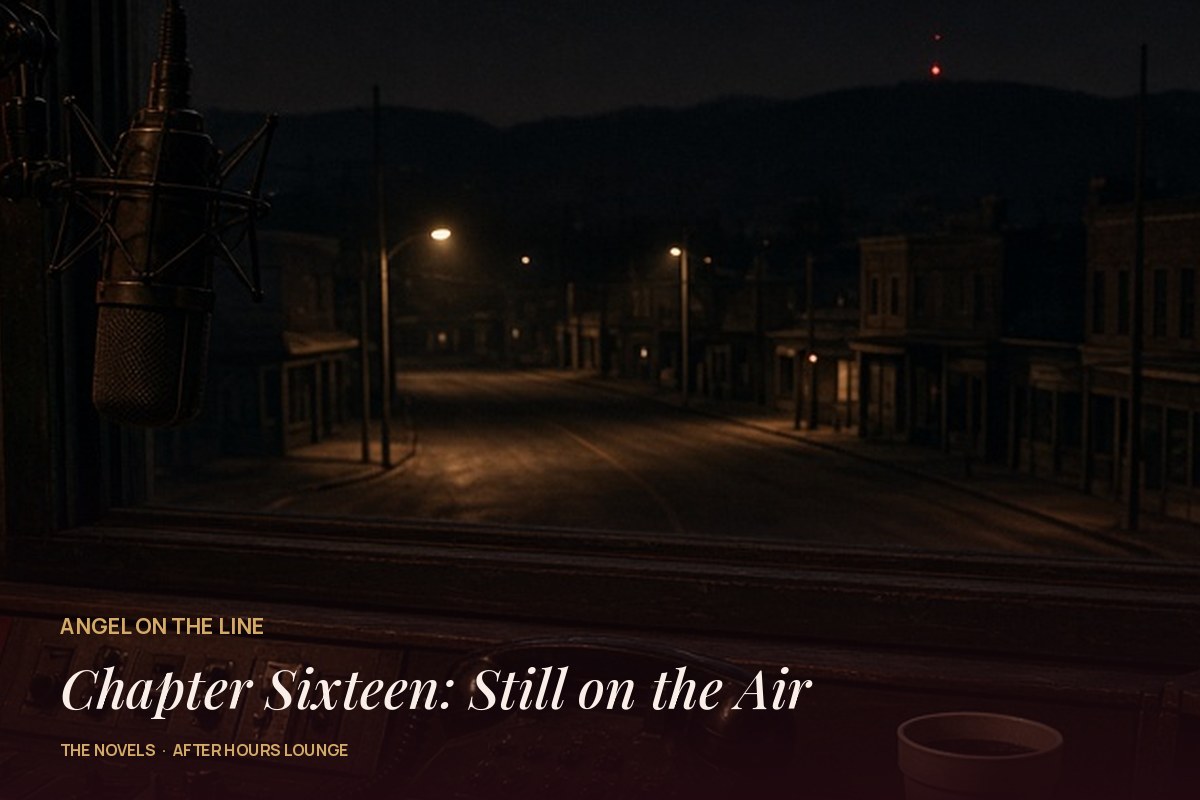
It was the middle of the night. It was the cold of the year, a gray fine rain on the glass, and the red light on the ridge going on and off like a heart. There was no one in the building but a man and a woman in separate rooms, with a wall between them, and eleven thousand records.
At one o’clock he opened the microphone.
One. Two. Three. He sat with his thumb on the fader and heard, behind the wall, the sound he had known since 2002, a woman crossing a room, a hand on the shelf, the faint scrape of a cardboard sleeve. Five. Six.
The buzzer sounded.
It was the little push-button buzzer by the library door, that Walt had installed in 1996 to call a man out of the stacks, and that a woman had used for three years to say, without a word, to a man at a microphone: I’m here. One press, short and flat, in the control room beside him. He felt it in the board like a note.
He took his hand from the fader.
“Good morning,” said Elias Ward, to the county, at eight seconds past one. “This is WKAL, ninety-one point three, and you are exactly as awake as I am. I’ve kept something back from you for twenty years. It’s a record I never played myself. I’m going to play it now, all of it, because my sister asked me to, and because there is a woman in the next room who has earned it and knows what it is.”
He stopped. His throat was tight.
“It’s eight minutes and ten seconds. It’s a trumpet, and a very good one. It’s for Nora, who sat in this chair for twenty years and was better at it than I’ll ever be. And for—” He did not say the name. He did not need to. “Please stay with me. It’s a long one.”
He took off the headphones and went down the hall, through the dead air, at a walk.
The library door was open. She stood by the shelf in her long coat with the lamp on, a woman of forty-five with wet hair, a coat open on a black dress, and the white sleeve in her hand. A small brass key lay on the shelf by her elbow, worn bright. She had kept it two decades. He knew it at once.
“I didn’t want to be asked,” she said. “I wanted to come.”
“I know.”
“Then put it on,” said Clara.
He took the record from the sleeve in her hand, and they went back down the hall together, to the closet, where there was room for one chair and one person who did not mind standing close. On the console, squared to the edge of the board, lay the small blue square he had put there at a quarter to one. She saw it, and he saw her know it. She had taken the brass key from the shelf as they left the library; she set it down beside the cloth, the two small things together under the red light, and said nothing, and neither did he. He lowered the needle. The cans filled with the soft hiss, and then the chord, low and round, and the trumpet began to climb, muted and slow, up through the dark of the little room. She did not sit. She stood beside him with her shoulder against his arm, and he felt her breathe, and all eight minutes went out through the board and the cable and the transmitter and up the ridge, to the red light, to the county, to the pines and the pond and the hill, to an empty parsonage and a yellow house with its window dark, to a hillside under the rain where an old man lay, and to a spring where the water ran on over a woman’s ashes, and to the dark behind all the windows in Marlow Springs where people who could not sleep were turning their heads on their pillows and saying, Who is that?
At the place where the horn breaks, three bars before the end of the second chorus, she took his wrist.
She turned it up. She laid her thumb across the pulse.
“I’ve got it,” said Clara.
He could not speak. He stood with his hand open in hers, and the trumpet went down the long stair of its last chorus into silence, and the needle ticked on in the run-out groove. Neither of them moved. The rain ran on the glass. On the board the red light pulsed, and, distinctly, beside them on the console, the telephone began to ring.
They looked at each other.
“It’ll be the trucker from Dalton,” said Elias.
“It will not.”
“It’ll be the nurse.”
“Pick it up,” she said. She was laughing. The tears were running down her face. “Go on.”
He lifted the receiver and held it out. And with a smile he had not seen in twenty-one years, a girl’s smile, quick and sly and unashamed, she took it from him and put it to her ear, and said into it, in a whisper, in the exact cadence of his own voice, to make him laugh:
“WKAL. You’re on the air.”
The end.





























Leave a Reply