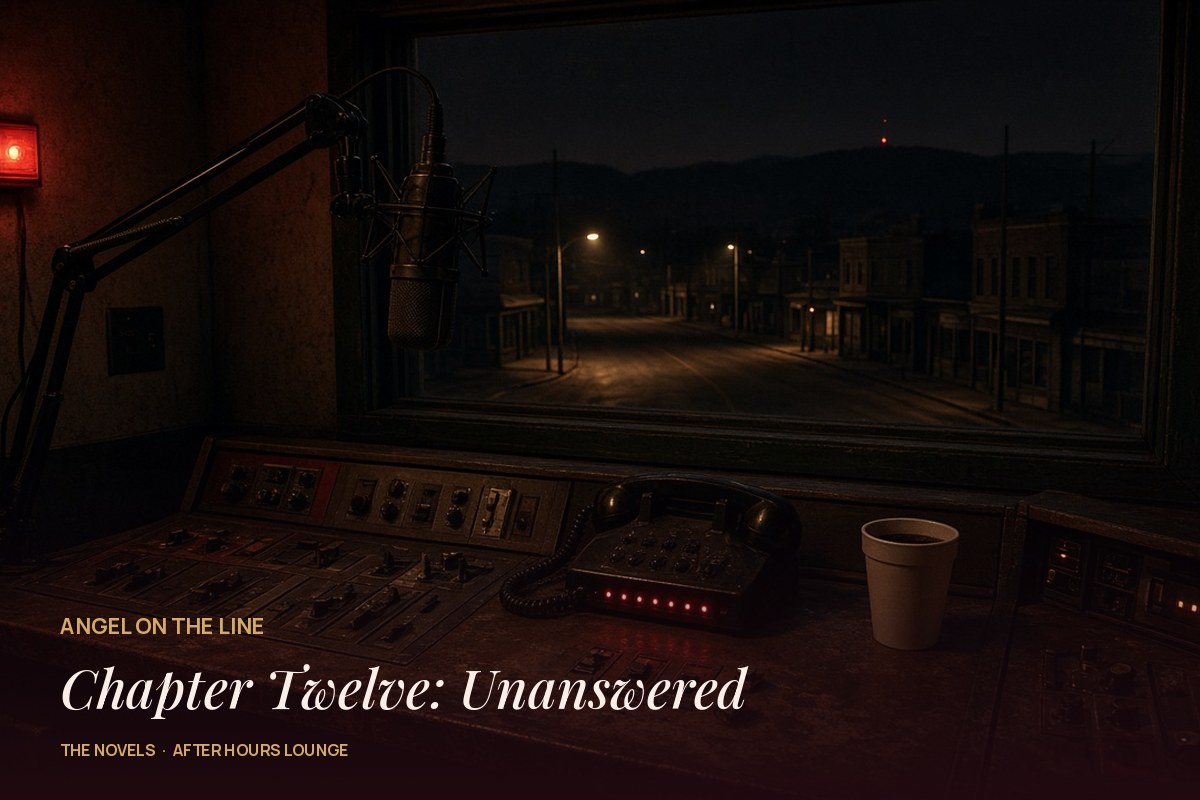
O my God, I cry in the daytime, but thou hearest not; and in the night season, and am not silent.Psalm 22
Nora told him on Wednesday, in the yellow kitchen on Fenner Street, over a pound cake that Opal Henley had not baked.
He understood that much before she spoke. The cake sat on the table between them under a glass dome, a plain gold loaf with a split down the crown, and Nora had cut two slices and eaten none, and she kept turning the cake plate a quarter-turn with her fingertips as she had turned a dial on the air. She was in the green scarf. She had put on lipstick, and it made her look, in the cold kitchen light, like a woman dressed for a visit to a judge.
“I told her everything,” she said. “Tuesday. I gave her the box.”
“What did she say?”
“She said, I never saw one.” Nora’s hands stopped on the plate. “She said it twice, Eli. In a voice like a girl. I believe her. I believed her before I opened my mouth. You’d better sit down.”
He sat.
“This is the other thing.” She drew breath. The concentrator in the corner pumped, patient and wet. “In April of 2018, a Thursday, Opal Henley walked into the lobby of the station with a pound cake in a Tupperware, and asked Walt at the front desk if she might have five minutes with Miss Ward. I took her in the back. She’d never been inside the building in her life. She sat in the chair by the coffee machine with the cake in her lap, and she told me, and I have been carrying it for eight years, and I am so sorry. I should have told you that night.”
He did not say anything. A truck passed in the street. In the bird feeder a jay was bullying a sparrow.
“In October of 2005,” said Nora, “the Reverend Rourke called Opal into his study and told her something about you. That you’d been seen at a motel in Atlanta, at dawn, with a young woman, on nights you were supposed to be on the air. That a deacon had seen it. That he’d told his daughter, for her own good, and that it had broken her heart, and that she’d gone away. And he said that if you wrote, Mrs. Rourke would bring whatever came to his desk, and Opal was to see to the rest. She wasn’t to open anything.” Nora’s voice was even. “He’d write on it himself. He said it was kinder that way. A man ought to be turned away by a man. Then she was to mail it back.”
“The woman at the motel,” Elias said.
“Was me.”
“And the deacon.”
“Was Lyle Bascomb, whose wife was having her hip done at Emory that week.” Nora’s mouth moved. “Lyle saw a man carrying a sick girl out of a ground-floor room, Eli. I don’t think he lied. I don’t think anyone in this story ever told a lie. I think Thomas Rourke was told a thing that was true, and he took the true thing and he stood it in front of his daughter like a pane of glass.”
The kitchen was still.
“She sent them back,” Elias said. He heard his voice, and it was a reasonable voice, and it sounded a long way off. “I mean he. He did. He sent them back. She never—”
“She never knew.”
“Forty-one.” He could not seem to lift his hands from his knees. “Forty-one letters. Twenty-one years. I sat in that pew.”
Nora did not look away.
“I knelt at the rail, Nora. In front of the whole town. I asked him where she was, and he said, Brethren. Let us pray for our brother.” He heard a laugh come out of himself, short and appalling. “He prayed for me. He had my letters in his hands, every one. He prayed.”
“Eli.”
“Eight years.” He looked up. “You’ve known for eight years.”
She did not look away. It was what he would remember afterward, that for the whole of the next minute his sister, who weighed eighty-one pounds and had a tumor in her bone, sat in her yellow kitchen in her green scarf, and looked at him, and did not look away.
“Yes,” she said.
“Why?”
“I was going to tell you that night. I had my coat on. I had my hand on the doorknob, and then I thought, if I tell him, what does he do? He drives to Atlanta. Or he drives up the hill, and he breaks down that old man’s door, and he does something he can’t undo. Or he sits down on the floor of my kitchen and doesn’t get up. And I thought, wait. One week, until I see how he is.” The concentrator pumped. “I waited a year. In the spring of 2019 they found the lump.”
He closed his eyes.
“The second one. The breast. The one the radiation gave me, for the first.” She said it plainly. “And I thought: I can’t. If I tell him now, he’ll go to her, and I’ll be alone in a hospital with a nurse and a window. If I don’t tell him, he’ll stay. I didn’t say it that way to myself. I said it was the wrong time. I said it for eight years.” She breathed. “I needed you, Eli. That’s the whole of it. I wanted you in the room, and I could think of a hundred reasons why it was kind, and not one of them was why.”
He opened his eyes. The cake was still on the table, with the split down the crown.
“Opal made me promise not to tell you,” she added. “She asked to tell Clara herself, someday, in her own time. She never did.” A pause. “I’m not saying it as an excuse.”
“I know you’re not.”
“Say something.”
“I can’t,” he said. And then, after a long time, because she was his sister and she was dying, and because there was nothing in all the years that he had ever wanted less than to be right about her: “You gave her the box.”
“Yes.”
“You could have given me the cake.” He did not know what he meant. His voice broke. “You could have told me.”
“I know.” Nora put out her hand across the oilcloth, and he took it, and they sat holding each other’s hands like children at a table, with the cake between them. “I’m telling you now,” said his sister. “It’s late. I’m so sorry it’s late.”
He did not remember leaving. He remembered that he had been driving for some time, and that the road was the county road to the spring, and that the pecans were down in the ditches and the light was low. He remembered parking. He remembered the old stone basin under its hornbeams, the steam lifting off the water in the cool, and sitting on the lip of it in his good coat with his hands hanging between his knees.
He did not go in. He sat. The water ran into the basin, and out of it, as it had for a thousand years, and the steam went up between the black trees.
He thought of Opal Henley on the first Monday of December in 2005.
He had gone to the church office in his one tie, at nine in the morning, with his hat in his hands. She had been at her desk, a younger woman then, brown-haired, in a green cardigan, with the Rolodex at her elbow and a photocopied bulletin under her hand. When she saw him come in she had stood up so quickly that her chair rolled back against the file cabinet, and for a moment he had thought she would call out.
“Mrs. Henley, I’m sorry to trouble you. I only want to know how I might reach Clara.”
“The pastor is not in,” Opal had said.
“I can wait.”
“He is not—” Her hand went to the blotter, to a glass paperweight, and moved it a quarter of an inch to the left. “The pastor is not in, Mr. Ward.”
He had looked at her. He had thought: She is a decent woman who has been told to say a sentence. He had stood there, in the smell of toner and floor wax, and felt such a strong wave of pity for her that he had said, “Thank you, ma’am,” and turned, and gone out, and left her standing behind the desk with her hand on a piece of glass.
He had pitied her. That was the thing that he could not stand. For two decades he had pitied her.
He put his thumb to the wrist where the stitches were, and pressed, and there was nothing there but his own blood going about its work.
Walt was in the front office when he got to the station that evening, with his boots on the floor.
That was how Elias knew. In thirty years he had never once seen Walt Dupree take his feet off the desk before the six o’clock news, and tonight the boots stood side by side on the linoleum, neatly, like a pair waiting to be fitted, and the Atlanta paper lay folded on the blotter with the crossword blank. A trumpet case sat on the floor beside the filing cabinet, black, scuffed gray at the corners, its clasps held shut with a length of electrical tape. The old man was not looking at it.
“Nora called,” Walt said. “This afternoon. Said you’d had a bad one and I’d best be here.”
“She told you.”
“She told me you’d want to ask me something, and I was to answer it straight.” He took off his glasses and pressed the bridge of his nose. “Go on, then.”
Elias had not known what he would ask until he stood in the door with his coat on. “The nights I was in Atlanta,” he said. “In ‘five. You ran the tape.”
“I did.”
“And she called. You told her I was on a run.”
“Twice, in September, a week apart. I said it exactly that way. The boy’s on a run.” Walt put the glasses back on. “She said thank you, sir, and hung up, and I sat with the receiver in my hand and felt as if I’d shut a gate on a child. I told you so at the time. You said it didn’t matter.”
“I didn’t know what it was.”
“No. I did, some of it.” The old man turned his chair a quarter turn toward the window. “Your sister came to me in this room the week the doctors gave her the name of it. She had a new scarf on and her chin up. She shut the door. She said, Walt, I need you to run tape on the Thursdays and not ask where he is, and if the Rourke girl calls, he’s on a run. I said, honey, that’s a lie. She said, it’s a loan, I’ll pay it back. She was twenty-two years old.” He spread his hands on his knees. “I’d have lied to the Pope.”
“She never paid it back.”
“No. I don’t believe she was able.”
Elias came in and sat on the edge of the desk, where the boots usually were. Elias told the rest plainly: the Reverend’s study, the motel at dawn, the deacon, forty-one letters sent back, Opal Henley and her pound cake in the lobby in 2018, which Walt remembered, and had not understood. He did not say her father. He said the Reverend, and Walt’s mustache moved once, and was still.
“Lyle Bascomb,” Walt said, to no one. “I played his girl’s wedding in ‘eighty-eight. He cried at the cake.”
“I didn’t know about any letters,” Walt said at last. His voice had gone rough and level. “God help me, son. I thought she left because she wanted to. I thought a girl who goes on a Friday night with her life in two suitcases has her reasons, and the reasons are the business of the people they belong to. I minded the switchboard. That was all I was doing. Pulling a plug when a child asked me nicely.”
“Nobody lied,” said Elias. “That’s what Nora says. Every word anybody said was true.”
“Then it was a hell of a way to build a thing.” Walt looked at him for a long time. “I’ll tell you what I can’t get round. If Nora asked me tomorrow I’d do it again. A sick girl asks you for a small thing, and you give it, and the small thing turns out to be twenty years. I’d do it again, and I’m sorry anyway. Both at once. You can hold both, you know. I’ve seen men hold worse.”
He looked, Elias thought, like someone who had spent two decades waiting to be sentenced and had been told instead to go to work.
“And that buzzer,” Walt said abruptly. “I put it in the library wall in ‘ninety-six, for the transmitter, when you were seventeen and I couldn’t get you out of the stacks to save my life. I knew who was in that room after dark. I’m old, son, I’m not blind. There was a Buick behind the dumpster three nights a week for three years, and I never said a word, because the show had never sounded warmer.” He almost smiled. “A man leaves a button on a wall, he doesn’t ask what it’ll be used for.”
With a sock-footed toe he nudged the trumpet case a few inches along the floor and back again.
“Nora asked me for something in April,” he said. “For the end. I told her I hadn’t blown a note since ‘oh-six, and she said then you’ve got till the autumn. I’ve been out in the truck every night this week with the windows up, making a noise like a goose.”
“What did she ask for?”
“It’s hers to tell.” He picked up the boots, one and then the other, and set them back on the desk, and the old chair complained under him. “Go on. You’ve got a show. The line won’t keep itself open.”
It was as near as Walt Dupree would come to an embrace.
Daniel Whitlock came at four o’clock on Thursday.
Elias was alone in the studio, labeling the week’s tapes, when the front door stuck and gave. He heard it. He heard a step on the linoleum, light, measured, the walk of a man who has been in a great many buildings that were not his own, and then a voice at the glass.
“Mr. Ward?”
He was tall. He wore a gray wool coat that fit, over a blue shirt without a tie, and he carried himself with that mild upright courtesy of men who have spent their lives telling other men the hard truth about a roof. He was forty-nine, Elias knew. He looked, in the sodium light of the corridor, like a man who had slept badly and shaved with care. His eyes were hazel and tired and steady. He had a paper cup of coffee in one hand, and he held out the other.
“Daniel Whitlock.”
“I know who you are,” said Elias.
He took the hand. It was a good hand. Long, clean, dry, without a tremor, the hand of a person who trusts what he is holding. They shook once, formally, and let go.
“May I sit down?”
“There’s a stool.”
Daniel sat. He looked around the closet of a studio, at the board and the headphones and the cream-colored telephone, the clipboard on its nail, the long dark window onto the empty room behind. He took it in with a professional attention, and Elias saw him arrive at the telephone and stay there.
“That’s the line,” he said. “She calls on that.”
“Yes.”
“I wanted to see it.” Daniel lowered his cup. “I’m not here to make a scene, Mr. Ward. I don’t think that I’m able to. I drove up this morning because my wife told me something last night, on the telephone, that I think I’d known for some time. She told me about the box. About her father, and what he did. She was very calm. She said she didn’t want me to drive up, and that she needed to be alone with it for a few days, and that she’d call.” He paused. “I said I understood. And then I sat in my kitchen until three in the morning, and I realized that I wasn’t the person she thought I was, and that I had to come and say it to your face before I said it to hers.”
Elias did not speak.
“In October of 2017,” said Daniel Whitlock, “you telephoned our house.”
The studio was quiet. On the board the red light was dark.
“Her mother had died the week before,” said Daniel. “The funeral had been the day before. I’d driven her to it and driven her home, and I was in the kitchen making a pot of soup, because I had no other idea what to do with my hands. The phone rang. It was a Thursday. I answered. A man said, Is Clara there?“
“I remember,” Elias said.
“I said she was lying down. I asked who was calling.” Daniel’s eyes were on the telephone. “You said your name. And I knew it. She’d said it once, in her sleep, in 2013, and I’d lain there in the dark and decided that I hadn’t heard. And then you said, Tell her I’m sorry for her loss. You said it as if you had practiced it. And you waited.”
“I did.”
“And I said, I’ll tell her.“
He stopped. His hand had gone to the side of his face, and then, with an obvious effort, he put it back on his knee.
“I put the receiver down. I stood in the kitchen with the soup. And I told myself a number of things. That she was grieving. That it would be cruelty to put a ghost into a house in mourning. That it was twelve years gone, that you had no claim, that I was only protecting her. They were all true, and all of them were useful, and not one of them was the reason. I was afraid.” The word came out low and plain. “She had a place in her I could not get into. I’d spent five years trying. And a man had telephoned from that place, in her mother’s kitchen, and for ten seconds I held the door. That’s all it was. I held it shut.”
Elias sat with his hands on the board, as though it might move.
“I’ve been rehearsing this on the road since seven,” said Daniel. “I thought I might say I was sorry. I don’t think that it covers it. So I’ll just say what it was. It was a theft, Mr. Ward. I took nine years of your life from you, and nine years of hers, and I did it with a spoon in my hand.”
“I waited,” Elias said.
His voice came out of him from a long way down. He had not known it was going to.
“I called from the phone in the hall. I’d found the number through information. I’d read the notice in the Macon paper, Clara Rourke Whitlock, and I thought, She’s married. I’d known, I suppose, for years. But I read it in print. And I sat there on the floor of this building with the funeral notice in one hand and I thought, I’ll ask her once. One question. It was a Thursday, and a man answered, and he said he would tell her.” He swallowed. “I waited nine years for a telephone, Mr. Whitlock. I told myself she’d chosen. I told myself it was an answer. I never asked again, because you don’t ask a door twice that has been shut in your face.”
“I know.”
“You don’t know.”
“No,” said Daniel Whitlock. He said it with quiet exhausted decency. “I don’t. I’ll never know. That’s what I’m here to say.”
For a long time neither man spoke. Somewhere in the building a pipe ticked. On the clipboard behind them the sheets of the logbook moved a little in the draft from the door, Nora’s hand, and Elias’s, and Walt’s, a dozen years of the hours of a small station telling the dark what time it was.
Elias found, to his considerable surprise, that he was not angry. He had expected to be. He had expected a thing he could pick up and hurl. He found only a great tiredness, and under it, like a stone at the bottom of a pond, a grief that was not for himself at all.
“Does she know?” he said.
“Not yet. I’m going to tell her tonight. I wanted you to have it first.” Daniel set the cup on the edge of the board, carefully, as if it were a tool he had finished with. “I’m not going to ask you for anything. I don’t have the right. I’ll say only one thing, and then I’ll go. I am not going to hold the door again. Whatever she decides, whatever she does with those letters, I’ll abide by it. I’d rather lose her honestly than keep her the way I’ve kept her.” His eyes came up, hazel, red-rimmed and steady. “She has listened to you every night for a week. I’m not blind. I don’t know what you are to one another. I’d like it to be her who decides.”
“So would I.”
“Then we have that.”
Daniel rose. He stood for a moment at the glass, looking at the empty studio beyond it, the one chair and the one microphone, and the lit red button that had been, for all those years, a woman’s only way home.
“It’s a very small room,” he said.
“Yes.”
“I’d imagined it larger.”
He held out his hand. And Elias, to his own astonishment, took it, and the two men stood in the narrow room and held on to each other a moment longer than a handshake required. It did not forgive anything. It was only that they were two men who had been in the same dark room, and had at last come out into the light, and had no idea what to do with their hands.
“Take care of her,” Elias said.
“I’d like to say that I will,” said Daniel. “I’d like to be told that I may.”
He went out. The door stuck, and gave.
At six he did the thing he had not done since 2005. He went into the library, and took down the Hale.
It was where it had always been, in the third row, between a Hank Mobley and a Freddie Hubbard, its spine gone soft as a glove. He drew it out. He stood with the record in his two hands in the lamplight, the plain white sleeve, the crease at the top corner where a woman had once caught it on a shelf and laughed. Side two. Track four. He did not put it on the turntable. He only held it. It weighed what a record weighs, and nothing at all.
He put it back.
At midnight, when he took his seat in the closet and put the headphones on, he thought he knew what he would do, and then found he did not. He played a Mingus, and a Webster, and a long Ben Webster ballad that wandered home at last through a quiet field of its own saxophone. He took a call from the dog man. He took a call from the nurse. Then the board went silent, and the red light pulsed, and the clock on the wall said 1:00, and he opened the microphone.
One. Two.
Somewhere on a hill above the town, in a kitchen smelling of lemon oil and cold coffee, an old man in a cardigan sat by a window with a radio turned low. Somewhere in a yellow house on Fenner Street a woman lay with an oxygen line across her face and her eyes open. Somewhere in a room over a kitchen a man and a woman sat on either side of a box, and he did not know whether the thing the man had driven ninety miles to say had been said yet, or whether either of them was listening to the hiss.
Six.
He put his thumb to his wrist. He had thought it would be the same, but it was not.
Eight. Nine.
The phone did not ring. He had known it would not. It sat on the board with its cream-colored handset and its cord, silent, unanswered, and for the first time he looked at it not as a door but as a thing that a woman had the right to leave closed.
Ten.
“Good night, Clara,” said Elias.
He said it softly. He had not said her name aloud on the air in twenty-one years. It went out over the county, over the ridge and the red light and the black pines, over a church on a hill with a sheet of plywood in its west wall, and he took the fader down, and sat for some time with his hands open on the board, as a man sits who has put something heavy on a doorstep and gone away.





























Leave a Reply